
Half Suit circa 1590
Composed. Etched in the Pisan fashion. Pieces well matched in size and etching pattern. Consisting of a burgonet ( item number A-301), gorget of two plates (upper lames missing, item number A-149), a breastplate of deep peascod form ( item number A-235), asymmetrical pauldrons, arms ( item number A-242) and two gauntlets ( item number A-244 and item number A-357). The breastplate is missing its gussets. The form of the pieces represent very nice examples of the typical very late 16th century form.
Burgonet: Once piece skull rising to a high comb and extended at the front and back to form a brim and tail. Small cheek plates at each side. Etched in the Pisan manner. When purchased coated in old, browned varnish with some rust underneath. After cleaining, the surface is in reasonable shape with most of the etching remaining with good detail. There is some brazed repair to the top of the crest and a larger soldered repair to a small portion of one side of the crest. The point of the brim is slighly bent. Cheek plates not quite a pair. Nice full form with high comb and small cheekplates typical of the style. Currently displayed on the half suit item number A-249.
Gorget: Composed of a single plate front and rear of rounded form. Decorated with etched cabled bands filled with trophies-or-armour in the style typically described as 'Pisan'. Patches at the ends of the front plate at the pivot and closure. Originally would have had an additional pair of small neck plates.
Breastplate: Italian. Of deep peascod form with a roll at the neck and a flare at the waist. Etched in typical Pisan fashion. Gussets lacking. Flare would have originally carried a fauld of (most likely) one lame.
Arms: Italian. Good quality Italian arm harness and pauldrons etched in the characteristic Pisan fashion. Assymetrical pauldrons the left covering more than the right. Formed of a main plate overlapping two plates above and four smaller plates below. The lower plates on sliding rivets at the back and leathers at the center and front. The top most plates secured by pivoting rivets at the front and back. The next plate is secured to the main plate by a pivoting rivet at the back and a leather at the front and in the center of the back. Left formerly fitted with a mount for a reinforce. Arms with tubular upper cannons, two piece lower cannons connected by a bracelet couter with one lame above and one below the cop. The upper incorporating a turning collar, the upper section with two smaller plates articulated at the ends. Etching in bands along borders and at the center of each element primarily consisting of cable patterns and trophies of arms. Some leathers replaced, others missing. Some later rivets used to secure plates in the pauldrons. Some loss at the back of the left pauldron and some wear in the etching in the center of the back of the left pauldron.
Gauntlet: Italian. Good quality Italian gauntlet for the left hand (fingers and thumb missing) etched in the characteristic Pisan fashion. One piece cuff joined with a rivetted overlap at the inside of flared form with inward turned, roped roll at the edge and a parallel raised, roped line with etching in between. Plain inward turn at the wrist. Back of hand covered by 5 plates and a knuckle plate with rounded areas over each knuckle. Hand plates with internal assembly marks in the form of 5 chisel marks at the edge. Retains some gilding. Ends of the metacarpal plates at the thumb side with multiple decorative notches, single notches on the opposite side. Associated with a lower quality modern copy of a right gauntlet with similar etching. Modern copy not forming a pair.
Gauntlet: Italian. Generally described as Pisan. Widely flared cuff drawn out to a blunt point with central crease and an inward turned roll . Back of hand consists of 5 plates the terminal one lightly formed to the knuckles. Etched in bands. Border etched to simulate a recessed border. Knuckle plate etched to simulate a raised roped ridge. Cuff and back of hand with a wide central band of etching with two additional bands on the cuff. Iron rivets with copper alloy caps.
Displayed with a single tasset item number A-243. [inv. num. A-249]
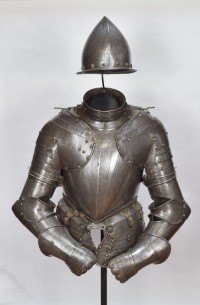
Italian Half Suit circa 1610
Etched in the 'Pisan' fashion. Comprising a cabasset, gorget, breast, back, tassets, pauldrons, arms and gauntlets.
Cabasset: Almond shaped skull with small stalk at the top, central crease and narrow flat brim. Etched in the 'Pisan' fashion. Brim with inward turned roped border with a narrow recess. Just above the brim there is a line of original iron lining rivets - most retaining original brass caps with decorative washers. Some cloth lining band remaining between a few of the rivets. Point with a nice stalk, bent over to the back. Etched with 6 bands of trophies. Each side decorated with a central panel containing an armoured figure in antique style flanked by angels.
Gorget: Etched in the 'Pisan' fashion. Typical Italian straight necked form. Formed of 3 pieces front and back, the main plates with a rolled lower edge and flared at the neck to match the neck lames. Main plates joined by a rivet on the left and a pin engaging a keyhole slot on the right. Upper neck lames joined by a hinge on the left and a pin on the right. Neck plates associated and etched to match. Originally the plates would have been attached with three leathers front and back, now riveted through leather and false rivet holes.
Breastplate: Etched in the 'Pisan' fashion. Formed of one plate with integral flare at the waist, inward turned rolls at the neck and arms and typical shallow peascod form. Etched overall with seven wide bands of decoration consisting of a central region with figures, trophies and foliage borded by three bands on each side, the central one roped. The central band with two medalions at the neck.
Backplate: Typical overall form. Made of one plate with integral flare at the waist, inward turned rolls at the neck and arms. The surface with raised bands at the neck and arms extending down in sevem bands to the waist. The bands and recesses etched.
Pauldron and arm: Etched in the 'Pisan' fashion. Separate pauldron and arm. For the right arm. Pauldron of 7 lames, 2 above and 4 below the large main plate (similar form and etching, but the right pauldron somewhat larger) The uper plates of the right pauldron are currently secured to the main plate by a rivet at the front and the back. Holes on the plates indicate that the second plate was originally secured to the main plate with a rivet at the back and leathers at the front and center. Outer edge of the main plates with inward turned and roped border. Bottom edge of the bottom lame turned n the same manner. Rectangular hole in the center of the bottom plate to engage a turning pin in the arm harness. Strap and buckle on the inside of the bottom lame to secure it to the pauldron. Arms formed of a tubular upper cannon with rotating collar, lower cannon of inner and outer plates attached by pairs of hinges at the back and a pin on the inner plate engaging a hole in the outer plate at the front, elbows of bracelet form joined at the back with rolled edges on the wing attached to the uper and lower cannons by one articulating lame.
Pauldron and arm: Etched in the 'Pisan' fashion. Separate pauldron and arm. for the left arm. Pauldron of 7 lames, 2 above and 4 below the large main plate (similar form and etching, but the right pauldron somewhat larger). Outer edge of the main plates with inward turned and roped border. Bottom edge of the bottom lame turned in the same manner. Rectangular hole in the center of the bottom plate to engage a turning pin in the arm harness. Strap and buckle on the inside of the bottom lame to secure it to the pauldron. Arms formed of a tubular upper cannon with rotating collar, lower cannon of inner and outer plates attached by pairs of hinges at the back and a pin on the inner plate engaging a hole in the outer plate at the front, elbows of bracelet form joined at the back with rolled edges on the wing attached to the uper and lower cannons by one articulating lame.
Tassets: Etched in the 'Pisan' fashion. Originally formed of one plate each with simulated separate lames. Three figure-8 steel buckles at the top of each tasset. These engage straps secured to the flare at the bottom of the breastplate. The tassets with lines of copper alloy rivets mimicing those that would be present on multi-plate tassets.
Gauntlets: Etched in the 'Pisan' fashion. One piece cuffs with overlapped join at the wrist. Metacarpal formed of 4 plates. Knuckle plate formed to simulate knuckles and etched to simulate a roped ridge. Interior of the metacarpal plates marked with single notch assembly marks on the front edge. Rivets replaced. Small patch to the thumb side of the second plate from the knuckle. Single rivet filling a hole in the edge of the cuff next to the metacarpal which would have originally secured the thumb defense.
Decoration not an exact match on the pieces (except the backplate), but of very similar form. The surface overall rusted and cleaned on all parts except the helmet. Much etching remains. Leathers and most rivets replaced. The tassets incorrectly cut apart and re-assembled. The 5 hand lames of the left gauntlet and the top plate of the left tasset replaced. The low, shallow form of the breastplate and the rounded form of the pauldrons indicate a very early 17th c. date for these pieces. The cabasset and one piece tassets would be typical of this later date as well. Includes item number A-102-a, item number A-102-b, item number A-102-c, item number A-102-d, item number A-102-e, item number A-102-f, item number A-102-g, item number A-102-h. [inv. num. A-102]

Italian Gauntlets circa 1550-1580
A pair of fingered gauntlets. Pointed cuffs of one piece with a central crease and joined at the inside of the wrist by 2 flush rivets. The seam stepped so that the outside is flush. The cuff is flared evenly thoughout its length. The outer edge of the cuff is bordered by a roped inward roll and a recessed border. The border includes a raised central ridge. The roll, central ridge and recessed border with single engraved lines. The back of hand is formed of 4 narrow plates toward the wrist and one wider plate at the knuckle. Each of the plates has a central crease with a notch in the edge aligned with the crease and a pair of incised lines parallel to the visible edge. The ends of the metacarpal plates have a shallow semi-circular extension with a small notch cut at the end of the extension. The extension allows the rivets to be mostly aligned with the edge of the plates. The knuckles are covered by a single plate with a central raised and roped ridge and the outer edge is shaped to the fingers. Thumbs of one large plate with a raised central tear-drop and scales covering the thumb. The main thumb plate is attached to the larger metacarpal plate by a hinge with one rivet on each end. The metacarpal plates are slightly boxed. Small finger and thumb plates replaced. Fingers re-leathered. Rivets replaced. Cleaned over-all. Cuff at the wrist roughly three and one half inches in diameter. Outer edge of the cuff tear-drop shaped 6 inches by 5 one half inches. Cuff 5 inches long at the point and 2 inches long at the inside of the wrist. Metacarpal app. 4 inches across at the knuckle plate. [inv. num. A-46]

Two knee length tassets circa 1550-60
One for the right, the other for the left. Each formed of eight plates. The plates are secured by two internal leathers, one at the front, the other at the center and a row of sliding rivets at the outside. The edges bordered by rolls, recesses and a raised decorated line in the middle of the recess. The rolls are all full inward turned rolls stepped at the overlap to allow the plates to sit flush. The top plate shaped to the bottom of the fauld, the lowest lame shaped to the knee and embossed with leaf form decoration. The plates for each are marked with internal assembly marks consisting of notches on the inside of the plates at the bottom edge between the central leather and the sliding rivets. On the left the notches go from 2 to 7 starting from the bottom, on the right the order is reversed - starting with one notch on the top plate and ending with seven on the plate above the embossed knee plate.
This style of decoration is associated with higher quality black and white armors from the mid 16th century. See item number A-96, item number A-30a and item number A-241 for other examples of similar decoration in the Allen collection. Similar items in Graz and Churburg we made by Michael Witz the younger and Sebasian Katzmair.
Buckles removed relatively recently. Some losses to the embossing. Each shows signs of having been adapted from a different, earlier style. The central leather covers a hammered out recessed band which had a central crease and the third lame from the top has a roll across much of its bottom edge. The existence of keyholes at the rivets, a spare hole next to one rivet and no slot on the bottom of the third plate shows that in the previous form the tassets could have been separated into upper and lower sections in the same fashion as item number A-181. In this form, the tassets were likely black and white. The medial edge on the right is cut around the crotch, the left is cut straight.
For fun, the first three images show the same tassets, but in very different lighting. The first appears to be outdoors under sunlight. The second is inside a light tent with two softbox lights, and the third used the same softbox lights but without the tent. Getting pictures of shiny armor can be challenging. [inv. num. A-336]
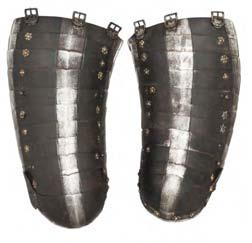
Pair of knee length tassets circa 1560-70
Black and white. Formed of eight lames with detachable poleyns of 4 lames. The tassets are divisible between the fourth and fifth lames. The bright band at the center is bordered by narrow recesses, the borders on the side are recessed with a narrow raised edge simulating a roll on the outside and a small roped inward turned roll on the inside. There are white bands down the middle and on each side. There are three buckles on each for suspension from the fauld. The segments are secured by keyhole slots and pins on the outside and pins with hooks on the inside. Decorated with original brass rosette washers and a few replaced pewter rosettes. There are remains of a leather strap at the edge of the outside. This would have been used to limit the motion of the sliding rivets or possibly to secure a lining. The image of the separate pieces of the right tasset with the poleyn from the outside shows the knee at full bend. Both tassets include marks which are likely to identify the matching tassets among others - 7 punched marks on the lowest lame of each section that separates and on the wing of the cop. A very similar pair from the same source: item number A-356.
Provenance: Brunswick Ducal Armoury - Wolfenbuttel, Schloss Marienburg.
The form, style of decoration, decorative washers and way the parts are secured are the same as the elbows on item number 18 in the exhibition of Brunswick armour at the Tower of London April 10-Oct. 31 1952. These have been painted to mimic more typical black and white armor decoration while the ones in the exhibit are all white except for the narrow lines. [inv. num. A-181]

Pair of Tassets circa 1560-70
North German, Brunswick. Each formed of 8 lames which can be separated between the fourth and fifth lames. Extended by a detatchable poleyne of four lames, the third forming the cop. Each with three buckles for suspension from straps on the fauld, mounted with decorated plates (three on the left well matched and almost certainly original, one on the right well matched, one broken and likely a contemporary replacement the third cruder and either associated or, more likely, modern). Lower edges of the two tasset sections with inward turned rolled borders with a narrow recessed band. Medial edge of the plates continues this full inward turned roll. The rolls are terminated on each lame where the next plate overlaps to allow the plates to align nicely at rest. Lateral edge with a false roll just formed as a bump. This continues for the full height of each lame because it can overlap and not interfere with the fit of the plates. The medial roll extends along the edges of the poleynes and down on the lower edge. The lateral bump extends along the edge of the top plate of the poleyne. The lowest plate does not have either on its lateral edge. The cop includes an oval wing with central pucker and full inward turn at the edge. The top edges of the tasset plates and top and bottom of the cop have a bevelled edge which still shows signs of original file/grind marks. Rivets with (possibly later) pewter rosettes. Some delamination. Good hammered internal surface. Exterior almost certainly originally bright. Plates secured by internal central and medial leathers (secured to each plate by pairs of rivets) and sliding rivets laterally. Left retains the additional internal leather past the sliding rivets. The right has lost most of this leather, but we can see the holes or rivets that would have secured it. Interestingly, there are pairs of holes in the two upper poleyne lames for a (missing) internal leather, mimicing tasset construction and different from many knee lames. Retains a (later) strap and buckle at the center of each knee cop. Rivets, holes and bits of leather show where there would have been another strap at the bottom of the bottom lame of the poleyne and around the leg at the seventh lame. Leathers broken in some places. Some leathers likely working life, others appear to be more modern replacements. Segments joined with a large keyhole on the lateral side engaging a stepped, domed head rivet and a smaller keyhole engaging a turning pin on the medial side. The tassets can be worn as displayed, or as short or long tassets. A very similar pair from the same source: item number A-181.
Thickness: measured on a few plates of the left varies between .060 and .022 inch, generally the top lame is app. .055, the next lames .035. Knee cop app. .045 with some thicker areas on the wing.
Weight: Right 3 pounds 8.4 ounces (1600g), left 3 pounds 10.4 ounces (1650g).
Provenance: Brunswick Ducal Armoury - Wolfenbuttel, Schloss Marienburg, Property from the Hanoverian Royal Collections sold Olympia Auctions 8 Dec. 2010 lot 169. [inv. num. A-356]

Tasset circa 1610-20
Italian. With blued and gilt decoration. Separates into two parts between the ninth and tenth plate. The join formed by a keyhole and button laterally and a pin with a vertical hole (likely originally engaged by a hook, now missing) medially. The tasset formed of sixteen upward lapping plates with a poleyn of five plates. The top plate is boxed to fit to the flare at the base of the breastplate. The exposed edges of the plates with five points each and bordered by three parallel engraved lines. The cop of shallow form with a mostly flat wing. Articulated with two lames above and two lames below, the final lame larger and cut with a rounded (patched) bottom edge. Decorated with gilt rivets and engraved lines. Apparently originally the plates were attached using three internal leathers and had an additional narrow strip at the ends of the plates. Each of these leathers would have been secured by a single rivet per plate (may rivets remain for the central three leathers). Some modern patches at plate 14 and terminal plate. Leathers broken. Now loose or secured by modern bolts at the outer edges. One odd modern welded vertical strip providing some additional stability. Originally one of a pair in the Higgins Armory, the mate sold separately at a subsequent sale.
Provenance: John Woodman Higgins Armoury Inv. Nos. 927.4.a and b from Dr. Bashford Dean, Riverdale, New York, 28th September 1929
Measurements: 29 in. (61 cm) long. [inv. num. A-223]

Pair of tassets circa 1610-20
Of large size composed of three separable portions. Ex Higgins Armory from which it was sold at Thomas DelMar March 3, 2013 lot 342 where they were described as:
each formed of twenty upward-overlapping lames divisible between the tenth and eleventh and terminating in a winged poleyn of five lames originally detachable the uppermost lame of each tasset fitted at its outer end with a later buckle and the eleventh pierced with a pair of lace-holes the main edges of the cuisses and their poleyns formed with finely file-roped inward turns bordered in the case of the uppermost lame of the cuisse with a matching roped rib and their subsidiary edges bordered by pairs of incised lines (lightly patinated overall with some small patches of active corrosion) 75 cm (29 in).
Provenance
- Cyril Andrade Ltd London No. 398 16th May 1930
- JWHA Inv. Nos. 1145.a-d

Tasset circa 1620
for the right thigh. From a Cuirassier armour. Main tasset of 10 plates. The upper plate boxed to fit to the flare at the base of the breastplate and with a keyhole slot to be secured to a stud on the breastplate and a washer that secured the central strap. The bottom 8 plates with a central crease and notched at the top. Detachable poleyne of 4 plates. The third forming a cop. Recessed borders on the sides of the tasset plates. The cop and lower plate without a crease. The tasset retaining some original leathers at the center and inner edge. Poleyne secured to the tasset by a rivet engaging a keyhole slot on the outside and a small turning pin on the inside of the leg. Retains much (possibly original) russet finish. Mounting for original horizontal straps found on the seventh lame of the tasset and the center of the cop. There appears to have never been any strap to secure the terminal lame of the poleyne to the leg. I assume this means that it would have worked like a simple cupped terminal tasset lame since it would never have been worn with a greave. From the Armoury of the Princely House of Hohenlohe-Langenburg, removed from Schloss Langenburg.
Thickness: (taken with the slots compressed and leathers pretty flat) inside height 18 in., outside height 20in., top 11 3/4 in. wide, bottom 5 5/8 in. wide.
Thickness varies .039-.060 in. Mostly .045-.055 in.
Weight: 5 pounds 1 ounce (2295 g). [inv. num. A-248]

Knee portion of tassets mid 17th c.
Forming a pair. Each consisting of a central plate formed to the knee and extending to a wing at the lateral side. Overlapping two lames top and one lame bottom. Top with an additional large plate. Bottom with an additional plate. Edges with plain inward turned rolls. Decorated with rivets at the center of the plates. Other similar items include item number A-22, item number A-155 and complete tassets item number A-331-f. [inv. num. A-364]