


I have brought along a selection of pieces from my collection to illustrate how I have chosen pieces for my collection, and what I have learned from them.
 |
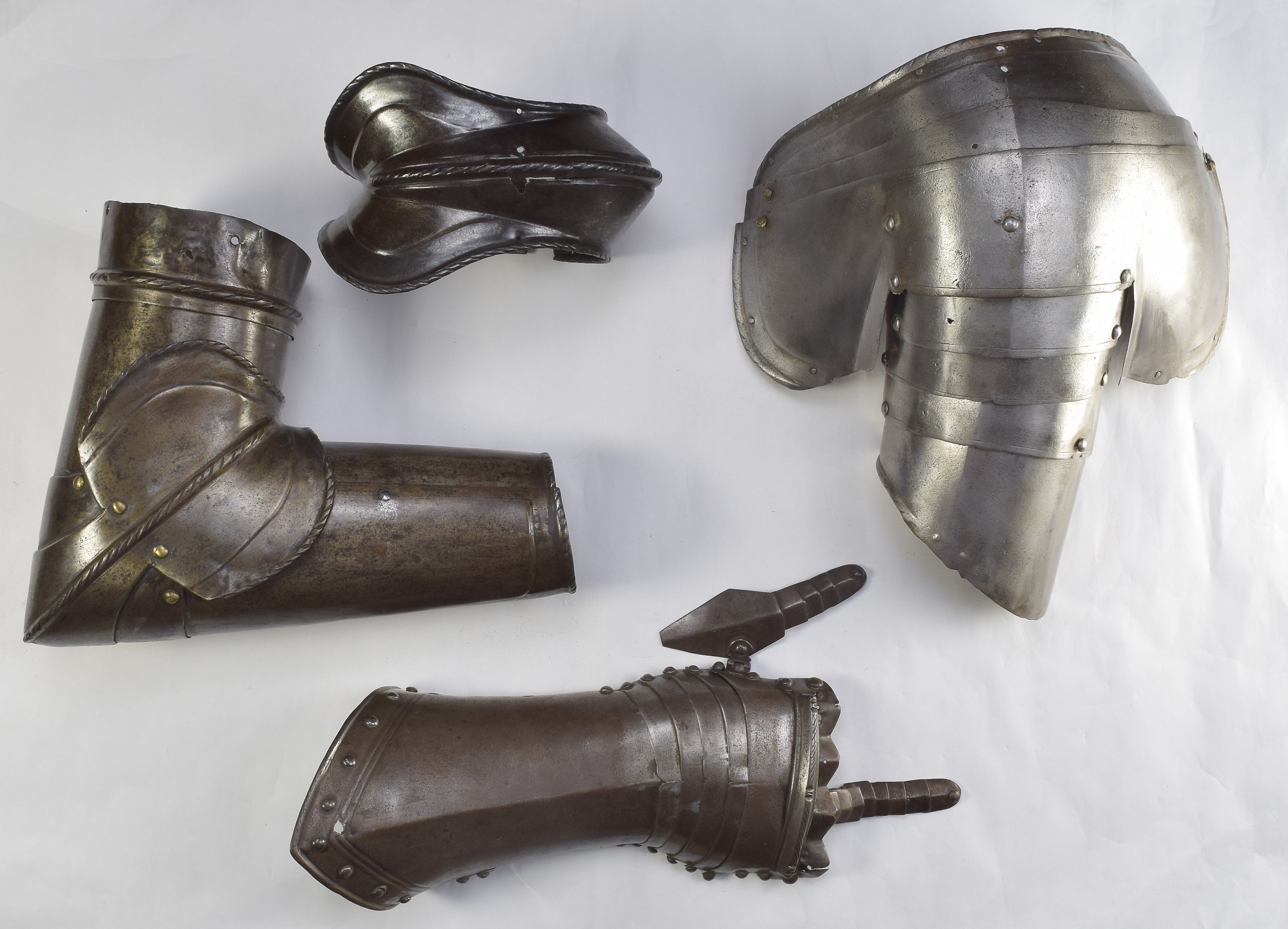
Floating elbow circa 1560 Italian. Of nearly bracelet form. There is a narrow gap of app 1/2 inch between the rear edge of the cop and the wing. The cop is asymetric, being flatter at the back and rising to a peak at the center from slightly behind the point of the elbow through the wing. The wing is slightly larger on one side than the other indicating that this is a right elbow. The outer edges are rolled and roped for their entire length. The roll is bordered by a recessed border on the front portion of the wing. There is a central raised roped band running along most of the raised portion of the cop. There are 2 holes on the front and one at the back for attachment of the cop to the vambrace plates. There is an old collection number in white paint ('178') on the back of the wing. Some delaminations on the inside. Height of cop app. 3 1/2 inches, and the wing app. 5 inches. Length app. 7 1/2 inches from the point of the elbow to the opposite edge of the wing. Weight 9.6 ounces (275 g). [inv. num. A-24]
This is the first piece I bought. It is just an elbow, but it still has a lot to offer. It allows me to understand how thick armor really was, it illustrates where form needs to be in an elbow, shows how roped borders were made and illustrates the springiness of the piece. It may also have an original finish. |
|
| |
 |
Italian Pauldron mid to late 16th cent Large main plate overlapping those above and below. 2 plates above, 4 below. Main edges with inward-turned rolls and recessed borders. For use with a floating elbow or with elbow gauntlets. Brass-capped rivets. Leathers and some rivets replaced. Top plate cracked at the center with a modern riveted patch.Additional patches stabilizing the rear connection between the main plate and the first upper plate. Where necessary for replair some original capped rivets have been removed (and preserved separately) and replaced by solid iron rivets. Painted on the interior with "H.10". Thickness varies between .022 and .058 in., mostly .035-.040 in. There seems to be very little pattern to the thickness variation. There has certainly been some loss due to oxidation. Measurements: height at the crease measured over the outside 12 1/2 in. length of the top of the main plate 17 3/4 in. (9 behind the crease, 8 3/4 in front). Weight: 1 pound 13.6 ounces (840 g). [inv. num. A-35]
When I purchased this, it was very badly stabilized. All of the lower plates were riveted solid using crude nails. Even in this state it shows a lot. The form of the upper plates is very asymmetric. It is rounded over the point of the shoulder, dished at the back, and angled forward and curved under in the front. All of this is important to fit the body, but not necessarily obvious from pictures. |
|
| |
 |
Arm harness circa 1540-60 Formed of an upper and lower vambrace articulated by means of one lame below and one lame above to the bracelet cop. The upper vambrace includes a turning collar which was originally directly attached by a sliding rivet at the back and two leathers to the pauldron. Rolled and roped borders at the wrist and on the edge of the wing. Simple outward rolls at the inner edge of the upper and lower vambraces (at the elbow). Elbow of very pointed form with full bracelet wing. Horizontal raised and roped ridge on the outside from the point of the elbow to the center of the wing. Iron rivets with brass caps articulating the plates and attaching the hinge for the lower vambrace. Turning collar 4 3/4' in diameter. Lower vambrace 9 3/8' long at the longest point. Upper cannon .030-.050' thick, lower cannon more even .030-.040' thick. [inv. num. A-27]
This and the next piece came together. With these we now had access to a shoulder, arm and gauntlet. This let us build two suits with a lot more information about the actual form of 16th century armor. The arm illustrates the turning collar, decorative details and a bracelet elbow cop. The geometry of these elements is very ticklish and playing with one for a while really helped us understand them enough to make pieces that worked and looked right. |
|
| |
 |
German fingered Gauntlet (possibly Brunswick) circa 1540-60 Long, pointed cuff formed with a gentle even flare over the entire length of the cuff. Central point. Border rolled and roped with an additional double row of raised decoration. Lining rivets around the edge of the cuff. Back of the hand covered by 5 articulated plates, the final plate larger than the rest. Knuckle plate decorated with a roped ridge with additional decorative grooves at the end and center. Thumb plate attached by a hinge. Fluted plate joining the knuckle plate to the fingers. One finger remaining. Interior cuff plate missing. Originally it would have been secured by a hinge on one side (half of the hinge remains) and a pin on the other side that would have engaged in the hole in the outer plate. A gauntlet of similar form with similar edge decoration is in the Keinbusch collection in Philadelphia. [inv. num. A-28]
I won't pass this piece around because it is falling apart. The next piece illustrates most of the same details. We pulled patterns from this piece to understand how to get the back of hand to move correctly, and playing with the cuff helped get the feel for its elegant shape. |
|
| |
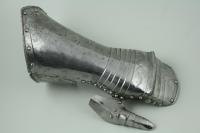 |
Half mitten gauntlet for the left hand late 16th century German, probably Saxon. Cuff with long flared and pointed cuff formed of an outer and fixed inner plate. Back of hand covered by 5 narrow plates, one larger plate, a roped knuckle plate. The fingers half covered by three plates. Main borders with inward turned roped rolls and recessed borders. Retaining buff leather lining bands and strap for the palm. Cuff with small tear-drop shaped bump at the wrist. Cuff and terminal plate with recessed band that comes to a point at the center. Main hand plate with a raised area. All plates with central crease. Rolls and knuckle plate with fine roping. The small roll at the wrist on the inner plate is rolled out. Thumb replaced. Ex Coll. Ian Eaves then to Anthony De Reuck. With A d R collection tag. Measurements: finger lames app. .032 in thick, Cuff .045-.060 in. thick (mostly in the .05 range), inner cuff plate mostly .040-.050 in. thick, main metacarpal plate generally .045-.050 in. thick. [inv. num. A-224]
|
|
| |
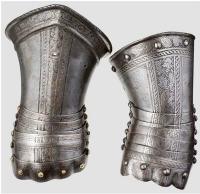 |
Gauntlet circa 1590 Italian. Good quality Italian gauntlet for the left hand (fingers and thumb missing) etched in the characteristic Pisan fashion. One piece cuff joined with a rivetted overlap at the inside of flared form with inward turned, roped roll at the edge and a parallel raised, roped line with etching in between. Plain inward turn at the wrist. Back of hand covered by 5 plates and a knuckle plate with rounded areas over each knuckle. Hand plates with internal assembly marks in the form of 5 chisel marks at the edge. Retains some gilding. Ends of the metacarpal plates at the thumb side with multiple decorative notches, single notches on the opposite side. Associated with a lower quality modern copy of a right gauntlet with similar etching. Modern copy not forming a pair. [inv. num. A-244]
This was sold as two gauntlets, one original. I expect that it hadn't been long since they had been displayed together on a suit. They serve to illustrate a lot of things that differentiate a real gauntlet from a much less well executed reproduction. Ignoring the etching and the remains of gilding, the form of the cuff, the form of the back of hand and the interior are dead give aways. |
|
| |
 |
Gauntlet circa 1600 Gauntlet. Full bell cuff. Metacarpal formed of articulated lames. Knuckle plate in the form of knuckles. Fingers and most of the thumb lacking. Base plate of the thumb protection remains. Shows atypical thumb protection used on some italian gauntlets where the entire thumb depends from a plate rivetted to the cuff instead of from a hinge attached to a metacarpal plate. [inv. num. A-78]
This gauntlet has a stable finish, so I can pass it around. It illustrates for the form we saw on the previous good gauntlet. |
|
| |
 |
German Gauntlet (part) circa 1490-1500 Finger, knuckle and 1 1/2 metacarpal plates of a German Gothic mitten gauntlet. The finger lames are fluted to simulate fingers, the knuckle plate with rounded and creased knuckles. The first metacarpal plate is fluted with v-shaped puckers to accommodate the flutes in the knuckle and finger lames. There is half of the hinge used to attach the thumb plate, and half of the second metacarpal plate remaining. Each of the articulations is formed with sliding rivets with slots app. 1/4 in. long. 2 rivets have been lost, the parts held together by bolts. Formerly in the collection of Leonard Heinrich - armourer to the Metropolitan Museum of Art, NY. Thickness: Generally around .030 in. The back of hand plate is pretty consistently .028-.032. The knuckle plate varies more, generally .025-.030, the finger plates vary even more - .020-030. The hinge is folded over. The overall thickness of the two layers is .060 at the bend, the actual metal is likely a little thinner. The pin is .090 in diameter, the hinge is .450 wide at the pin. The partial plate is 3/4 in. wide at the center, .7 in. at near the bulge at the end, .85 at the bulge for the rivet. The second finger plate is just over 1 in. wide. The first plate is app. 1 1/16 in. wide. The main hand plate is 2 in wide at the first knuckle tapering to 1 11/16ths at the fourth knuckle. Weight: 4.6 ounces (130 grams) There are often questions about how the flutes can work through the range of movement, esp. where the knuckles interact with the metacarpal. The last two images posted show the interaction between the metacarpal and knuckle plates when the hand is straight and when the sliding rivets are fully compressed and fully extended. These show that they really don't work all that well when fully compressed and straight. They do look and work pretty well when somewhat bent and extended. This is just sort of the nature of movement when one plate has tapering flutes. [inv. num. A-47]
I like this piece very much. It has been extremely useful in discussions related the operation and form of gothic and early 16th c. mittens. It probably has no real "collectible" value. This is an example of needing to understand the goal of the collection when buying items. |
|
| |
 |
German Black and White Elbow mid 16th cent. Elbow cop. Floating (originally held to the arm with a strap and buckle around the elbow and a pin suspending it from the upper arm). Decorated with raised foliage against a rough background (likely originally blackened). Raised areas with simple etched decoration. Recessed border with high quality etched decoration of foliage with 'dot' background. This elbow was claimed by the previous owner (optimistically) to have been formerly in the collection of Stephen Granscay. Since he also claimed it was in the Allentown exhibit, maybe he was thinking of the elbow later added to my collection as item number A-221 which better matches the description and includes appropriate collection tags. Traced back to lot 504 from the Sothebys European Works of Art sale held in New York November 25, 1986. [inv. num. A-96]
This elbow would have been part of an extremely nice, but still not princely armor. The decoration is similar to that on Allen item number A-241, but it is nicer. It has very nice roping, and it has etching in the border and on top of the leaves. |
|
| |
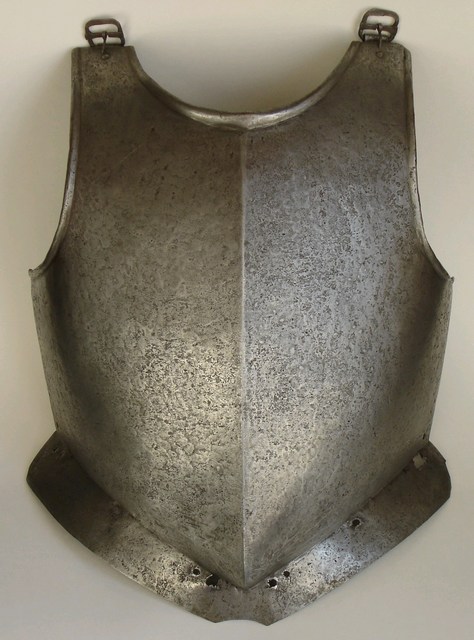 |
German/Austrian (possibly Gratz) Breastplate circa 1590 Including 2 buckles at shoulders. Rolled edges at arm holes and neck, full flare at waist - used without any fauld lames. Simple peascod shape. This breastplate is relatively light and most likely sword proof and not shot proof. This item is very similar to large numbers of breastplates in the Arsenal in Graz. Its original blackened finish has been removed by cleaning with acid. Originally it would have been used with a pair of tassets suspended directly from the wide flare at the waist of the breastplate - taking the place of the fauld. The holes for the tasset straps are evident. Each tasset would have been suspended by 3 straps and buckles - the ones nearest the edge and center of the breastplate were attached by 2 rivets, the central one with a single rivet. Weight 3.5 lbs. rough inner and outer surfaces, but roughly .050-.060 inch thick overall. [inv. num. A-15]
This is a light breastplate, almost certainly only sword proof. It illustrates how simple a piece can be, but still have very good form. |
|
| |
 |
Shot proof Breastplate circa 1600 Simple one piece breastplate with central crease which droops to form a peascod at the waist. Arm and neck holes with simple outward-turned, lightly roped rolls. Flaired at the waist. Pierced with holes for shoulder straps at the shoulders and with pairs of holes for three straps on each side to secure tassets. Rough from the hammer finish. Proofed with a musket in the chest. Marked with an unidentified mark resembling '8Z'. Minor delaminations on the outside and some major delamination in the inside near the center of the neck. Measurements: Weight: 16 pounds 9.2 ounces. (7,520 g). Thickness at the center of the bottom half up to 0.340 in. but generally closer to 0.290-0.320, in the top it reaches 0.350 inches near the center, tapering down to 0.250 in. at the shoulder, and down to 0.130 in. at the sides. [inv. num. A-209]
This is a very similar breastplate. It is much thicker and would have been built to be shot proof. 3.5 pounds is very different from 16.5+. |
|
| |
 |
Breastplate circa 1550-60 Innsbruck. Officer quality black and white with embossed vine and leaf decoration. Moveable gussets at the arms. Large, tapered, roped rolls at the arms and neck all coming to a point at the center. Original buckles at the top of the gussets, one damaged. Rolled borders of the arms augmented with a narrow embossed line at the center of the gusset. The neck accented by a raised polished section with a parallel raised liine and a small secondary chevron at the center. Roping aparently filed - the rolls with an overall even (not embossed for the ropping) surface. Breastplate with a central crease and deep rounded point at the center. De-laminations on the inside in the lower section of the point and some small ones on the surface. One old patch near the center of the flare and one later patch at the left fauld rivet hole. Black refreshed, white areas lightly cleaned. Gusset rivets replaced. Note from Ian Eaves states: This is actually a nice piece: an officers quality black and white armour made in Innsbruck about 1550-60. The main maker of such armours was Michel Witz the Younger (see for example an armour preserved in the arsenal at Graz). Particularly close in style is an armour by Sebastian Katzmair of Innsbruck in Schloss Churburg (no 118 in the Trapp , Mann catalogue of 1929 as I recall). The breastplate decoration is very similar in form to the breastplate on CH S118 in Churburg (illlustrated page 329 of the new 1996 catalogue and plate LX (b) in the 1929 Mann and Trapp catalogue) and the armor illustrated as plate 74 in the 20th anniversary catalogue of the Lauder collection at the Neue Gallerie (in that case, with an undecorated cuirass). Weight: 6 pounds 9 ounces (2975g). Height 13 1/2 in from center of neck roll to center of waist flare, 15 1/2 in. from top to bottom of center point of the flare, 11 3/8 in. wide at the waist, 13 1/2 in. under the arms. Slot in the gussets app. 3/4 in. long. [inv. num. A-241]
Sometimes you luck into things. I got a note from another collector about an item. The picture I saw showed it painted all black. It didn't look like all that much, but after a very light partial cleaning and re-attaching one gusset, I have something that is pretty rare. |
|
| |
 |
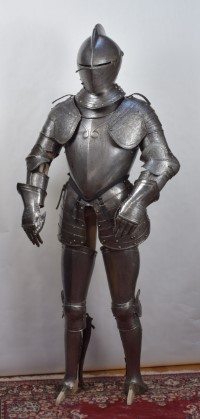
Three quarter armour circa 1590 German. Nuremberg. Overall rough from the hammer with blackened finish decorated by recessed polished bands and inward turned, rolls. The majority of the rolls are roped. Comprising a burgonet, curirass with fauld and tassets, gorget with munions, elbow gauntlets and simulated mail sleeves. Burgonet with one piece skull rising to a high comb at the center and extened to form a brim at the front. With two cheek plates and a separate tail lame. The cheek plates are extended to match the length of the tail lame with separate fixed plates. The edge of the brim, cheek plates, tail and a raised circular area in the middle of the cheek plates are polished bright against a blackened background. The edge of the brim and lower edge of the tail and cheek plates are bordered by inward-turned, rolled borders. The edge of the brim shows a delamination and crack which exposes wire in the roll. The cheek plates are pierced with 5 holes over the ears. The burgonet has a tubular plume holder decorated with diagonal lines secured to center of the back. There are remnants of lining leather at the brow and tail. The interior of the tail lame includes some signs of old painted arsenal or inventory markings in red and yellow. These appear to be 18 or 81, U8 and ZS. The inside of the skull shows signs of earlier raised or recessed bands that have been removed during the working life of the helmet. One cheek plate (the right) may be an old association. The right hinge is replaced. The breastplate has a deep peascod form with sliding gussets at the arms, a fauld of 2 lames, buckles at the shoulders and a roll at the neck. It is decorated by three recessed polished bands with central creases that continue on the fauld lames. The center of the bottom fauld lame is arched with an inward turned roped border. The fauld carries a pair of knee length tassets formed of seven plates which continue the recessed bands from the fauld at the center. There are raised bands on the inside edge continuing the central band from the fauld. The lower edge of the tassets is bordered by a recessed border and a tapered, inward turned and roped roll. The tassets are secured to the fauld by later hinged metal mounts. There are signs of holes for earlier straps and buckles on each side and the center of the tassets with matching holes in the terminal fauld lame. The fauld lames have holes formerly used to secure interior leather straps on each side. Some cracks to the fauld lames. The backplate is formed of 3 pieces and a separate culet plate. It appears to match the breastplate in form, decoration, mark, size and shape. The recessed bands on the sides have a crease at the center, the central band is flat. The bottom edge of the culet plate is cusped at the center. The main three plates of the backplate are certainly original and appear to have formed a cuirass with the breastplate. The culet lame may be later and the interior waist lame that joins them appears to be modern. The gorget is formed of two plates front and back. The main plates are formed to the shoulders, the upper plate tapers to the neck. The upper edge of the neck plates has a flattened inward turn. Munions of seven plates are attached to each side. These have a recessed and creased band at the center and a raised band at the front. The terminal plates are bordered by a recessed border and a an inward turned rolled and ropped edge. The intersection between the recessed border and central recessed band is decorated by a point formed in the border recess. The upper two lames appear to be associated and are possibly modern. The arms are covered by riveted mail with rings formed from round wire with pent roof overlaps and wedge rivets. These were later formed into the shape of sleeves. The elbow gauntlets include cuffs formed from two plates, back of hand covered by five plates, a knuckle rider and short mittens of two plates. The gauntlets are decorated with a central recessed band without a central crease. The border of the cuff is bordered by a recessed border and an inward turned rolled and roped border. The thumbs are protected by one main plate over the base of the thumb and three small scales over the thumb. They are currently secured to the metacarpal plates by a later leather. The gauntlets are nearly a pair. The right gauntlet has a rubbed mark in the recess of the cuff and signs of part of another one. The left gauntlet appears to have an associated inner cuff plate. The gauntlets and burgonet are likley associated, but the breast, back, tassets and gorget with munions are well matched. Some rust, most leathers lost or replaced, and some modern and likely Victorian replacements. Overall well matched armour. Measurements (in inches): Breastplate: 12 1/4 wide at the waist, 15 wide under the arms 10 1/2 wide at the shoulders with the gussets extended, 12 3/4 tall from the center of the neck roll to the waist at the base of the peascod, tassets 15 long at the center. Thickness .085-.110 in the center (mostly .090-.10) it is pretty consistent between the side bands. It thins to generally .060-080 on the sides with some areas as thin as .050. The gussets are generally .050. Tassets generally .050, some spots thinner. Backplate: 11 1/2 wide at the top, 12 wide at the center of the armhole (vertically). Thickness .050-.080, generally thicker at the waist and thinning toward the top. Side plates .040-050, mostly 040-045. The stand used to display the armour in its current form is displayed in the final pictures. The main image was taken on this stand. [inv. num. A-218]
I purchased this "suit" as a single lot. I don't do this very often, normally they go for more money than am willing to pay, and they usually don't have as much to tell me than smaller, cheaper pieces. This illustrates a pretty typical low end 3/4 armor for mounted or foot use from the late 16th c. It helps provide context for the bits and pieces that form most of my collection. |
|
| |
 |
Armour Late 16th cent A Composite Italian Full Armour of steel. Close-helmet with one-piece skull, visor, upper and lower bevor and 3 neck lames front and back. The skull rising to a tall roped comb (small holes near the top of the comb and one small brazed repair) swept slightly back, bordered by incised lines, with circular holes over the each ear in the form of a circle of 8 holes with a central hole. With a shaped plume-holder incised with chevrons at the base by one rivet on each side. Pointed visor with horizontal vision sight divided centrally, pointed lifting-peg fitting into the upper bevor. The upper bevor fits the visor exactly, the upper edge curved in at the back of the eye slot. Pierced with circular breaths in the form of a circle of 8 holes with a central hole (matching the holes in the skull, but forming a larger circle). on the right and pivoted at the same points as the chin-piece. Chin-piece and upper bevor secured by hooks which engage in to flattened pegs pierced with a hole. Face hole of the chin-piece bordered by a roped inward-turned roll. Face edge of the skull plain with single engraved line. Lining rivets around the face hole flush on the outside. Three neck-plates at front and rear (lower two rear plates replaced), the bottom ones each with turned and roped border and an additional roped ridge parallel to the border. Gorget of two main plates with single neck-lames at the front and rear. The outer edges of the main plates are bordered by a half roll and recessed border, the half roll roped. The neck edge of the main plates with matching roped half-rolls. The neck plates with roped full rolls. The neck plates are secured by an internal hinge at the left and a pin in the rear plate engaging a hole in the front plate on the right. The main plates are secured by a turning hook on the right which engages in a keyhole slot. Breast-plate of deep peascod form with medial ridge and two embossed volutes at the top, moveable armhole gussets, single plate skirt, and later fixed lance-rest. Back-plate shaped to the back and embossed with a 'V' towards the top. Inward-turned roped rolls at the neck, arms and on the edge of the narrow waist flare. Arm holes with recessed borders. Tassets each of five upward-lapping lames. The rounded bottom edge of the final lame with a full inward turn and parallel ridge, each roped. The ends of each plate with roped half-rolls. Each tasset with a central crease and small filed notch at the center of the top edge. Tassets originally designed for 3 buckles, re-fitted for 2 buckles to match the fauld lame on the breastplate. Right tasset with 2 notch assembly marks on inside of the plates. Originally acquired with later fully articulated vambraces each with turning joint, 6 lame pauldrons and floating elbow cops. Most commonly displayed with mid 16th c. arms from an English household - item number A-164 (right arm) and item number A-165 (left arm). Later displayed with item number A-339 (arms) and item number A-46 (gauntlets). Photographed with item number A-318 (greaves). Acquired with later gauntlets each with flared cuff and lames over the fingers (some missing - lost in shipment from auction house). Later full leg harness each hinged together and with articulated round-toed sabatons. Dome-headed rivets throughout. Originally on a padded wooden manikin with modern butted mail apron and mounted on a wooden plinth from its display since WWII. Remounted in the current collection. Helmet, breast and back similar to those on B-13 from Mantova. Gorget very similar to that on Corselet II.47 in the Royal Armouries (illustrated on plate LIX in European Armour in the Tower of London). Breastplate with narrow waist and very deep peascod. Some buckles probably original. Most rivets replaced. All straps replaced. As purchased it consisted of original parts purchased as a ""suit"" item number A-114a, item number A-114b, item number A-114c and item number A-114d and restoration legs and arms. [inv. num. A-114]
I had been looking for a close helmet for years. They always sold for more than I wanted to pay. That is probably a personal problem, but it is true. I ran across a badly illustrated, badly displayed lot in a catalog. The thing had rusted under varish, the stand was somewhat collapsed and the legs and arms were modern. I try to avoid buying modern pieces - they don't teach me anything about the real form or function, no matter how good they look. But there were enough good pieces in the middle, and the price was right. The legs are still normally displayed on the suit because I don't have good complete replacements yet. The arms are even worse, and I have found replacements, so they have been relegated to storage. |
|
| |
 |
Pair of greaves mid 16th c. Likely Italian. Formed of two plates, front and rear. Nicely shaped to the leg. The plates are joined at the outside by a pair of inset hinges and at the inside by two strips of leather that would be laced together. The hinges are secured to the inside of the plates. They sit behind the edge of the front plate and are set into cut outs in the rear plate. The edges of the plates are filed with small decorative notches at the hinges. This style of greave was usually used for the joust. It allows a little more flexibility in size and can offer some more contact with the horse. Mail added later, cut from a piece of near or middle eastern mail. Mail at the feet was common on Italian armours, but this is likely a later adaptation. The strips of leather on the inside are late 19th c. or early 20th c. Leather showing signs of the red rot that is typical of leathers of that period. They reflect the correct original construction with strips of leather with lace holes. [inv. num. A-318]
Greaves are hard to find. They are one of the more interesting pieces of armor. They are carefully fit to the human form and represent a very sculptural form. The greaves that came with both of my suits are modern, so I have been trying for years to obtain real examples. These represent an atypical style where the inside of the legs are not fully covered. These are usually associated with 16th c. jousting armors. They illustrate the shaping necessary for them to work, and little details like the file work at the hinges. |
|
| |
 |
Greave circa 1580 For the left leg. Consisting of two plates, front and back joined by two inset hinges on the outside and two pins on the inside. The top pin with a hook engaging a hole in the pin. Good full form rising high at the top and fully covering the heel. Fitted with pin and staples to secure the spur. Central creases in the front and back. Recessed border at the back of the knee and at the sides of the front plate. Narrow inward turned roped border at the back of the knee and a very fine outward turned roll at the bottom edge of the rear plate. Heavily oxidized with some holing. Modern patches at ankle. Pins and lower hinge replaced. Provenance:Property of a Distinquished scholar and collector, The Duke of Atholl, Blair Castle, Knight Frank and Rutley, London 26th July 1961 Lot 237 described as Scottish, circa 1500. Thickness varies significantly. Generally about .050 in. Thin spots .025 and at the rust hole at the upper back .15. Obvious corrosion loss. The measurements at about .050 or slightly above may be similar to the original thickness as there are some relatively smooth surface areas and there may be small remains of etching in the recessed bands. [inv. num. A-344]
This is another greave. This shows the type of thing that can be interesting to me. It has wonderful elegant form. It includes interesting details including the hook augmented catch and the spur mounts. But there is only one, and it is rotted, so it isn't really interesting to anyone trying to put together a decorative armor. |
|
| |
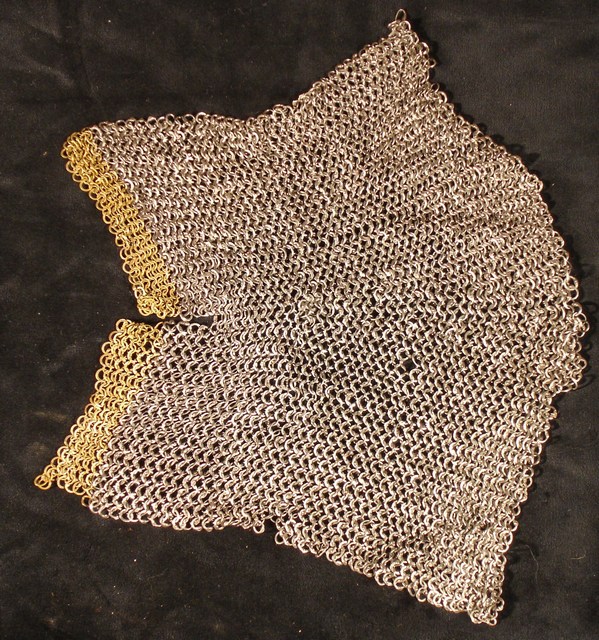 |
Mail Voider 16th century For the right arm. Rings of somewhat flattened form. Rings averaging app. 7 mm outside diameter. Overlap in the form described as pent roof on both sides. Wedge rivets. Tapered with expansion under the arm to accommodate the shoulder. Wider across the back. labeled as German. The pent roof shape of the overlap is associated with German manufacture. Small brass borders of alternating solid and riveted rings eleven rows wide (6 solid, 5 riveted.). The solid rings flat, the riveted rings of round section. Wedge rivets. Border is secured by a line of flattened butted rings indicating that it was almost certainly added after the working life of the piece. App. 9 in. wide at the cuff, 9 in. long at the edges, 10 in. long at the center and 15 in. wide at the base. Detail images over the scale show the outside and inside of the rings. Microscope images show: first and second show a broken ring where the rivet has held, though the top of the overlap has partially torn free, third shows striations (possibly from punching) on the solid latten rings of the edging, fourth shows draw marks on the riveted latten rings and burring on the punched rings, fifth shows the back of the brass wedge rivets and more striations on the punched rings, sixth shows the shape of a rivet hole in the latten rings - a trapezoid similar to a sharp-cornered USB connector. Detailed images and analysis by Mart Shearer. [inv. num. M-4]
This is a fine piece of mail. It illustrates tailoring to allow it to fit the body, decorative borders and very nice ring construction. |
|
| |
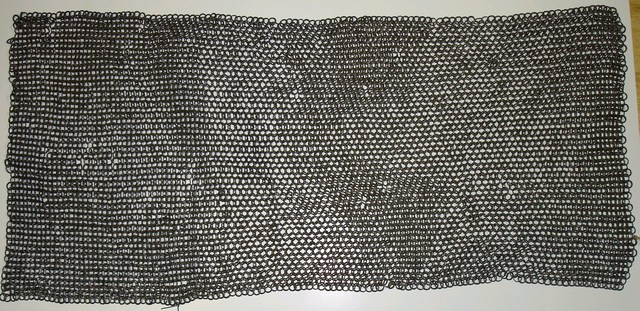 |
piece of mail 16th century Piece of mail. 16th century, likely German. Alternating rows of riveted and solid rings. Flattish form with swelling at the rivet. Watershed form on both sides of the rivet overlap. Rivet heads pronounced on the outside and flush on the inside. Rivets seem to be wedge shaped. Some losses. 10 1/2 in tall, 35 in. wide with the mail stretched wide. Rings vary in size, in general the riveted rings are larger than the solid ones, all somewhat larger than 1/4 in. inside diameter. Solid rings vary in cross section - some very thin, some more washer-like. Some of the solid rings seem to have some flats on the outer edge as if they were punched from sheet and sometimes a ring overalapped the edge of a previous ring. Includes at least one spot near a current hole that includes 2 rings that appear to be working life repairs. They are in a solid row and show distinct round rivets. Sample ring measurements - punched rings thickness - .050, .060, .082, .044, .055, .080, .060. Riveted rings thickness - .040, .055, .056, .045, .064. Outside diameter of riveted rings .415, .412, oval-ish one .400x.435. Inside diameter is hard to measure, but a few sample punched rings are .260 and a few sample riveted rings are .280. Detailed analysis by Mart Shearer adds: As Wade has already provided measurement for this well-made piece of mail, there are only a few other points to be made. The size of this rectangular piece without expansions could mean it came from the belly of a mail shirt, or a piece of horse armor, or it might simply be the size woven by the journeyman for addition into some later work by the master. Although well made, there are a number of single missing rings throughout the fabric and along the edges. Modernly, these are attributed to the fictitious ""mail-moth"", as if an iron eating variety of insect made holes similar to those made in wool by clothes moth larvae. Tom Biliter observed that one of these missing rings is surrounded by a number of rings which have been stretched into extreme ovals, as well as riveted rings which have opened or lost their wedge rivet. Another area has two diagonally placed rings folded like taco shells. It seems likely that these were caused by some heavy impact to the fabric by a piercing blow and a small or curved cutting tool. Whether these were caused in battle, or as part of a proofing of the armor, as possibly depicted in Biblioteca Apostolica Vaticana Pal.lat.1888, fo.18v, remains to be determined. The three micrographs show fracturing of the solid rings, which appears to be caused from the use of heterogenous plate as a base material to punch rings. These ""streaky steels"", as Dr. Alan Williams refers to them, can sometimes de-laminate due to the inclusion of silica stringers, forming grains in the steel. Another possible explanation would be the inadequate welding of smaller wire to form the solid rings. The rings were lifted for the micrographs using a blue ink, Uniball, micropoint pen. [inv. num. M-9]
This is an example of larger, cruder, heavier mail. This would be used in the body of a shirt, or in a horse armor. It also illustrates a different form of construction. Instead of every ring being riveted, every other row is formed of solid rings. Looking at them closely, we can see that they were punched and cut from sheet. |
|
| |
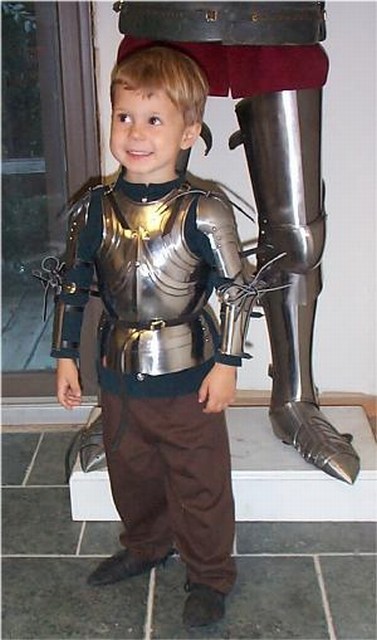 |
Geoffrey in Breastplate and arms circa 1480 Part armour. German style. Made as a costume for a 2 1/2 year old. Consisting of a breastplate and arms. The breastplate formed of an upper and lower breastplate, the lower carrying a fauld of three lames. The upper with small angular rolls at the neck and arms and with a pair of flutes inside the arc of the armholes. The lower rising to a central point with a simple fleur at the top and pairs of flutes bording the upper edge. The two pieces joined by a central bolt. The bottom edge of the lower breast flared to carry a fauld of three lames articulated at the sides with sliding rivets. The construction of the breastplate mimics item number A-330 which was added to the collection many years later. The arms of open form covering the outside of the arms, and consisting of a spaulder extended to the elbow, a floating elbow cop and a one piece vambrace. The spaulder with a large cop covering the shoulder secured to the upper cannon by two lames. The cop and two lames with three points on the lower edge. The plates are secured by sliding rivets at the back and leathers at the center and front. The spaulder, cop and vambrace secured by a pair of laces above and bellow. Worn with a doublet, pants and turnshoes. Patterns made by scaling down the patterns for a simple pair of arms designed by Wade and Aaron in the 1980's working as Valerius Armouries and scaled down breastplate from one Wade made in the early 1990's. Arm patterns require two of of the small pieces between the spaulder cop and cannon. I don't remember what was used for the third fauld lame. Armour and turn shoes by Wade Allen, doublet by Tracy Justus. [inv. num. R-17]
This was the first armor my son wore. The patterns came from old patterns I had lying around from our time building armor professionally scaled down using a copier. The shape is pretty good, and he wore it at daycare and trick or treating. This inspired the rest of the armors. |
|
| |
 |
Armour circa 1340 Patterned after images from the Romance of Alexander (Ms. Bodley 264) and related brasses from 1330-1350. Composed of a bascinet closely patterned after the tall rounded bascinets with small face holes, short sides and central crease in the Romance of Alexander with an aventail formed of two trapezoids (rear one slightly larger to account for the breadth of the back) with extensions at the face. Trapezoids with forty five degree taper (one extra ring per row) on each side. Aventail secured to a leather band which is secured to the helmet by brass vervelles. Lining of linen with loose tow stuffing secured to the helmet by stitches to small lining holes along the edge. Linen gambeson lined with cotton. Full haubergeon with two thirds length sleeves. Fitted with expansion from the waist up to the chest, in the skirt and tapered upper arms. Fitting in the chest adding 4 rings every other row. Fitting in the skirt of two added rings every other row in the back and the front formed with 45 degree additions on each side of the center which forms the point at the centre of the front. Haubergeon split in the front to the waist and with a short collar. Over the haubergeon the arms are covered by simple upper vambrace covering the outer third of the upper arm, a floating elbow with attached rondel and full lower vambraces of two plates joined by an inset hinge on the outside and strap and buckle on the inside. Body of the haubergeon covered by a coat of plates similar to Wisby #1. Cover of two layers of linen over 1 layer of canvas. Coat of plates includes shoulder plates. Legs covered by mail chauses on the lower legs, gamboised cuisses over the thighs and knees, simple knee cops and frontal greaves (schynbalds). Chausses covering the lower leg and foot with an attached leather sole. Cuisses of linen padding in differential thicknesses with raw, cleaned linen fibre. Surcoat of linen with appliqued coat of arms in wool. Shield of formed plywood covered with linen on the front and leather back. Face gessoed and painted. Shield with two enarmes and guige strap. External plates of 1050 spring steel. Knees and elbows raised. Bascinet formed of two pieces with central weld. Coat-of-plates plates of stainless steel attached to fabric with #14 brass escutcheon pins spaced at one half inch intervals on main body plates and three quarter inch spacing on upper and side plates. Rivets follow the outer edge of the plates in the upper plates and on side plates. Knees attached by Y straps on both sides with laces securing them to the cuisses. Elbows with central strap of a Y strap at the back and straight strap at the front and suspended from the upper vambrace plate by a leather strap. Vambrace plates laced to the mail shirt - the upper plate laced by internal leather tabs over the mail and the lower vambrace cannon laced inside the short sleeves. Most buckles forged of steel. Coat-of-plates buckles cast of nickel silver. Additional cloth coif of linen. Gambeson and cuises machine stitched, surcoat and coif with main seams machine stitched but all edge finishing,binding, and applique hand stitched. Mail 9mm flat ring with round rivets zinc coated, formed of scraps from 1250 hauberk and loose rings. Mostly assembled from rings allowing for tailoring as part of the constuction process. Geoffrey was 4 foot 8 inches tall and weighed 65 pounds at the time this was made. Total weight of the armour and clothing - 29 pounds. Armour by Wade Allen, all fabric garments by Tracy Justus. Constructed 2009 [inv. num. R-31]
This was the most complete armor that I made for my son. It was based on images from the Romance of Alexander (Ms. Bodley 264) a manscript written and illustrated in the 1340s. It was the heaviest armor he wore since it is a combination of mail and solid plate. It represents the transitional form used as the technology to make complete functional plate armor was developed. The mail is made of commercially available rings, but I assembled the garments. As usual, I made all of the plate armor from scratch. Since it had this much mail I had to start it early - in March. |
|
|