 .
.
 .
.
 .
.
Local armories would have been very common in 16th c. Europe. Maintaining enough armor to defend your town or manor was important. You were also required to provide armed men based on your wealth for the militia and the defence of the country. One of the better known surviving aromouries (at least in part) in England is at St. Mary's church in Mendlesham, Suffolk. As part of the work to preserve this armory, Ninya Mikhaila presented "Fytt for thy degree: Clothing and arming the Typical Tudor man" - an analysis of the records of armor that she found as part of her work for "The Typical Tudor." The work included data from many different inventories. The most complete inventory she referenced was the 1597 inventory of Helmingham Hall. Since she provided her source for the inventory, I decided to investigate whether there might be more information available, and what analysis might be possible based on that information.
Helmingham Hall was built by the Tollemache family in place of the previous Creke Hall. It was completed in 1510. It is a relatively original Tudor moated home, equipped to this day with a drawbridge. It is still owned by the same family, so its history is more stable and well understood than it is for most surviving properties.
There are some surviving inventories for the armoury at St. Mary's church in Mendleham and various mentions of the armoury in the account books.
They indicate that in 1588 the armoury included 2 corselets, 3 almain rivets, 4 pairs of splints, 1 jack, 3 guns with accessories, a bow and sheaf of arrows, 6 swords, 9 polearms and some other bits and pieces.
A summary of the armour present in 1588 includes (from a summary on page 19 of "The Mendlesham Armoury Research Project - Mendlesham Armoury Revisted - Revelations from the Parish Archives":
At Richard Manne's house:
A large part of the armoury of the Earls of Pembroke survived unti the 1920's at Wilton House. Much of it must have already been disposed of before
the sales in the 1920s because an anonymous captain of the Trained Bands who visited in 1635 wrote that it contained sufficient
warlike supplies to "completely furnish and set out 1,000 Foot and Horse." He also listed a number of the armours preserved there which included
armours that had belonged to Henry VIII and Edward VI in addition to personal armours of the first and second Earls.
(J. F. Hayward - The armoury of the first Earl of Pembroke, Connoiseur April 1964)
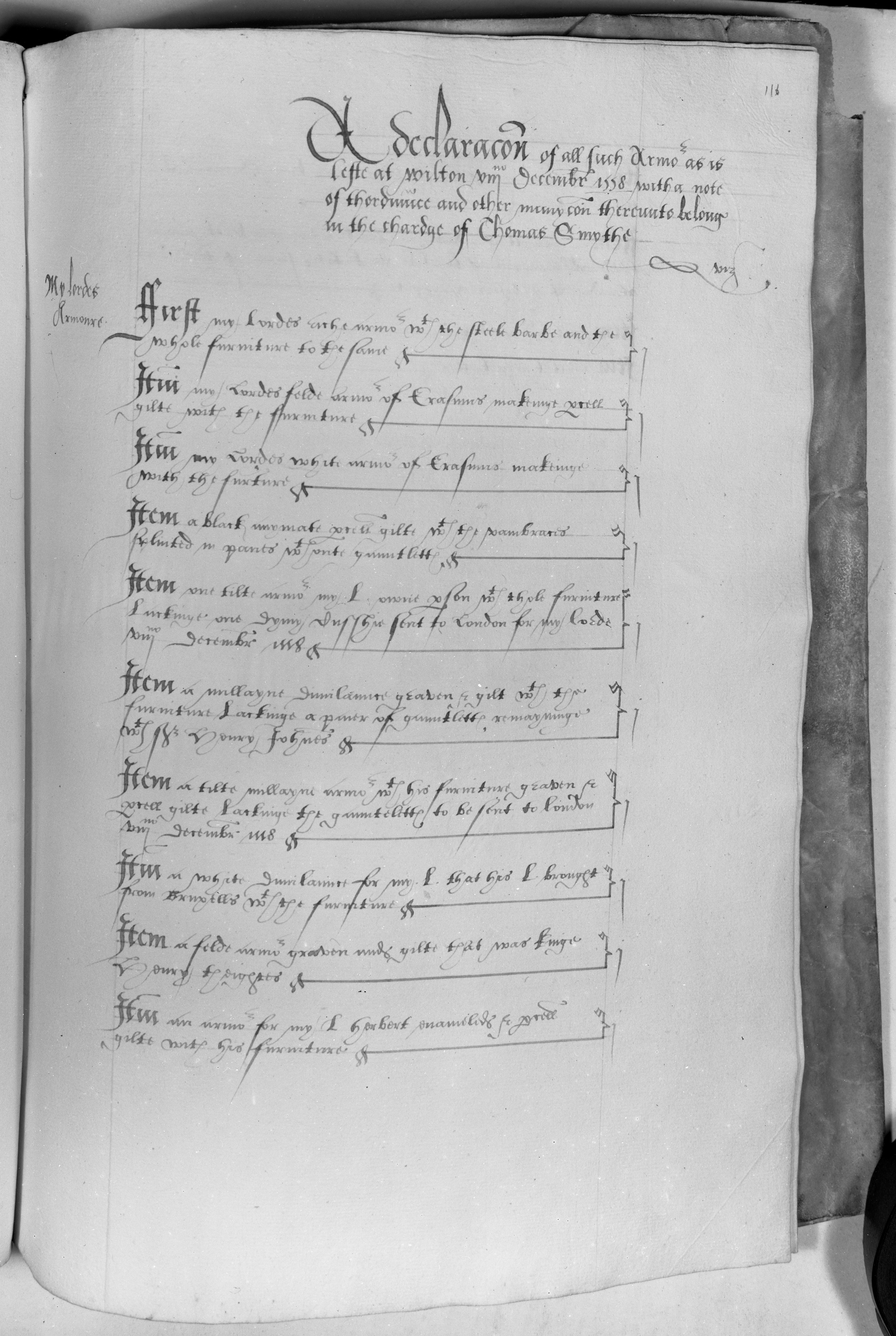
This list of important armours is incomplete. There is a surviving inventory from 1561 which includes on folio 116 verso and recto a list made
in 1558 of the armour preserved at the house at Wilton.
The transcription of the "important" page from Hayward is:
This assortment of high and and royal armours would have been reserved for a very important noble. Also, arming 1000 soldiers is far beyond the needs, goals or means of a local town or sheriff. It does show how extensive a private armoury could be.
A series of inventories survive for Helmingham Hall. They represent the contents of the hall in 1597, 1626, 1708 and 1741. These have been published in:
"Household Inventories of Helmingham Hall 1597-1741".
Suffolk Records Society Volume LXI
Boydell Press.
Woodbridge, Suffolk
2018.
Lionel Tollemache owned the house when the 1597 inventory was compiled. His father had died in 1575.
Lionel was important enough to have been appointed sheriff twice. He was also responsible for furnishing
a number of people for the muster put together in association with the threat of the Spanish Armada in
1588.
The publication includes the complete inventories, but I will focus on the entries related to the armoury. It appears that the armory was not inventoried in 1708. The rest of the inventories explicitly list the armoury as a room with contents.
The person producing this inventory makes a point to distinguish armor by the finish of armor and the intended use of the armor. Armors are described as "whit" and "black" armors. For armors of the same quality, one that is rough from the hammer and black cost significantly less than one that is polished. Polishing armor generally involved shipping it off to another trade to be worked with water powered wheels. First the piece is ground to remove the hammer marks and then at least one additional wheel is used to smooth the grind marks. The pieces are almost certainly shipped back to the armorer for assembly. In small shops, grinding and polishing would be done by hand, which took significant time and effort. So, when an inventory of items is made, the finish is used to indicate armors of different values.
The other obvious differentiation is between armors of different types. The three types listed are "almon ryvets", "corselets" and "horseman's" armor.
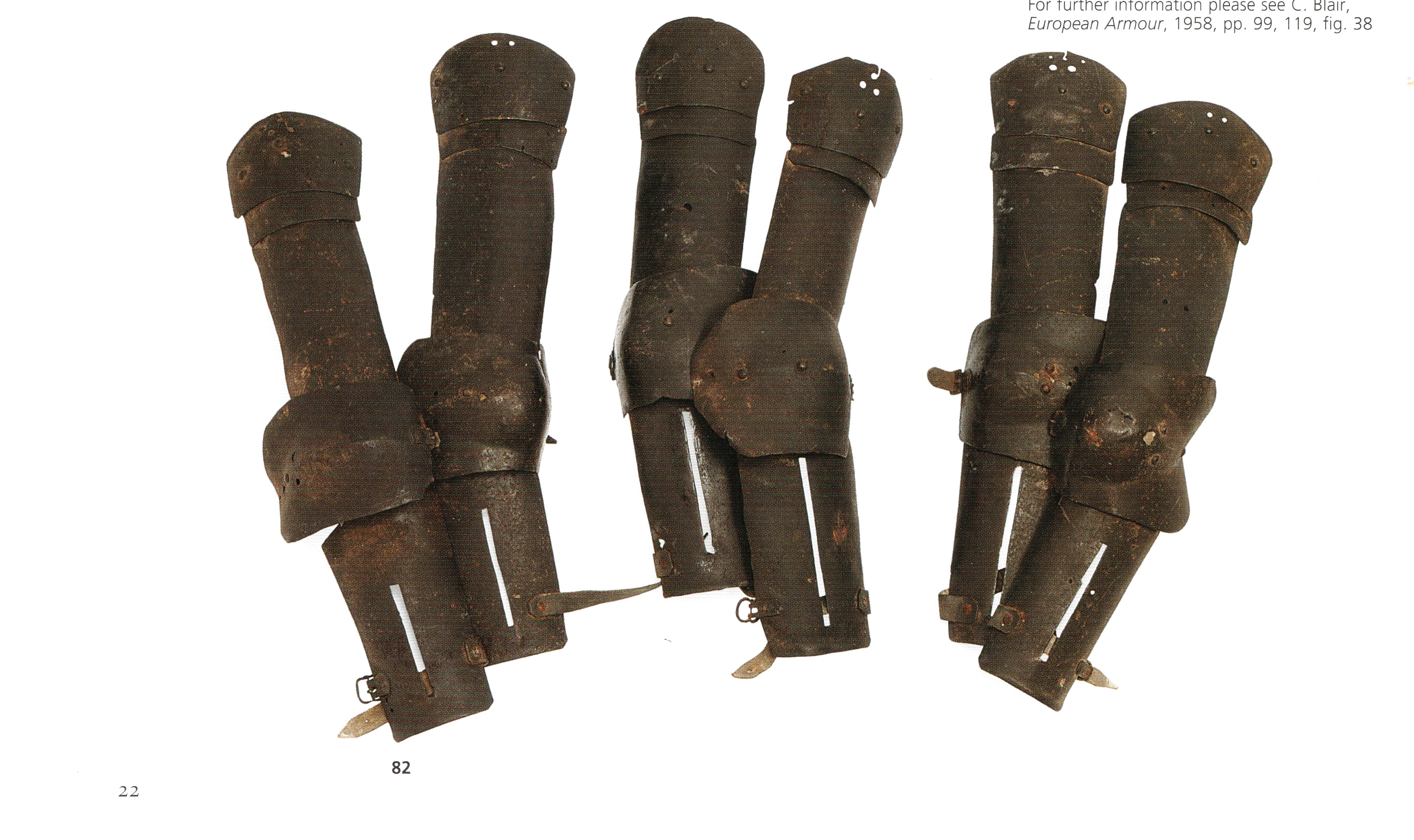
The "almon ryvets" (often called almain rivets or splints) are a type of armor that was made by the thousand in the early 16th c. for use by common soldiers. They consisted of a collar, breast, back, (usually) tassets, a particular style of arm and an open helmet. The collar may be entirely lacking, or it may consist of mail. The arms generally cover the outside of the arm and their defining feature is an integral protection for the back of hand secured to the vambrace by a slot.
The most published example is found in Winchester and (among others) is published in Arms and Armor of the Medieval Knight by Edge and Paddock on page 139. These pictures illustrate the form of an almain rivet using pieces in the Allen collection and Mendlesham:
.
.
.
It is worth noting that Ninya indicates that the definition of "complete" when describing an armor is that it includes protection for the head, torso and arms. Henry VIII's almain rivets are described as complete.
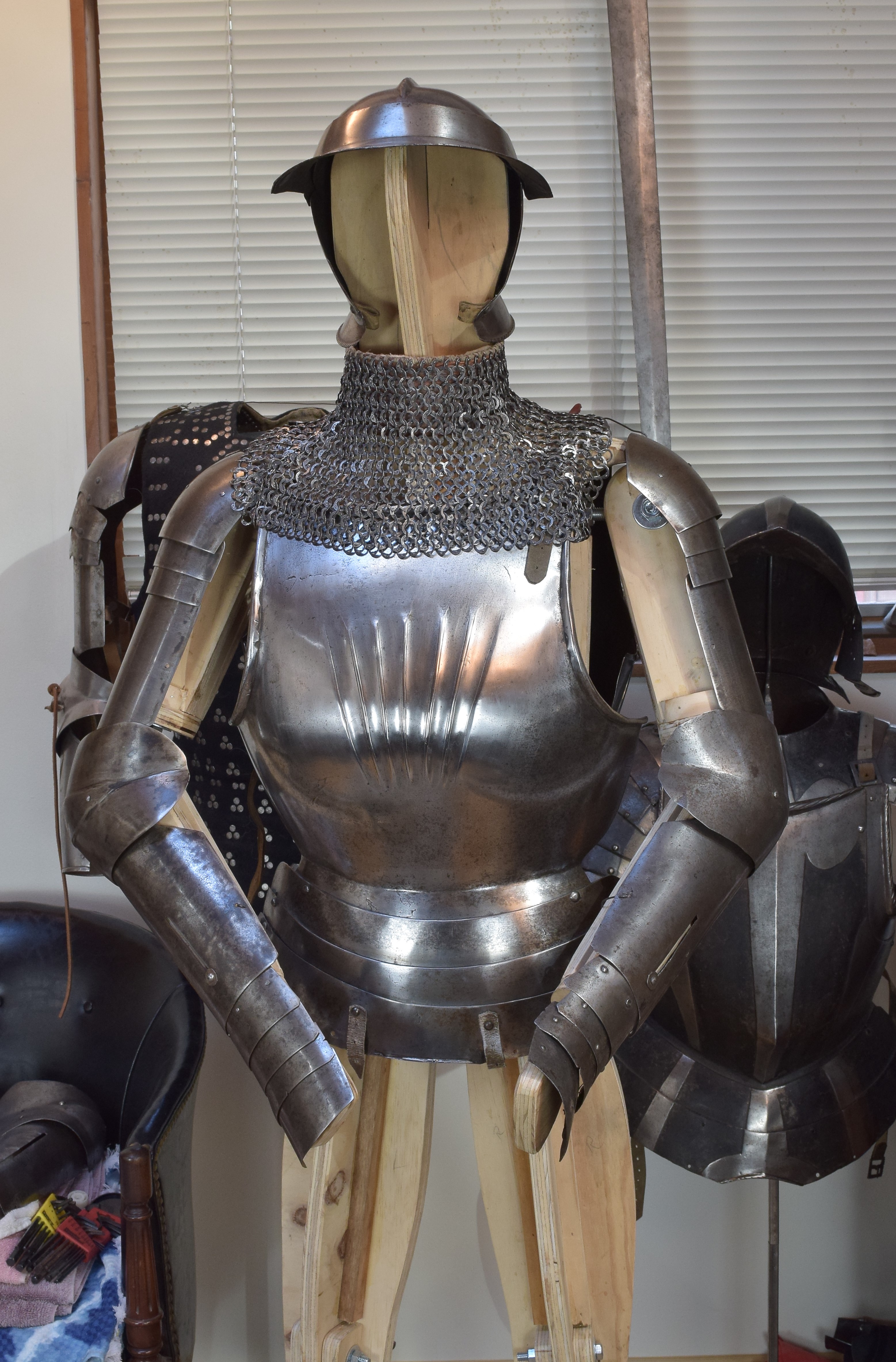
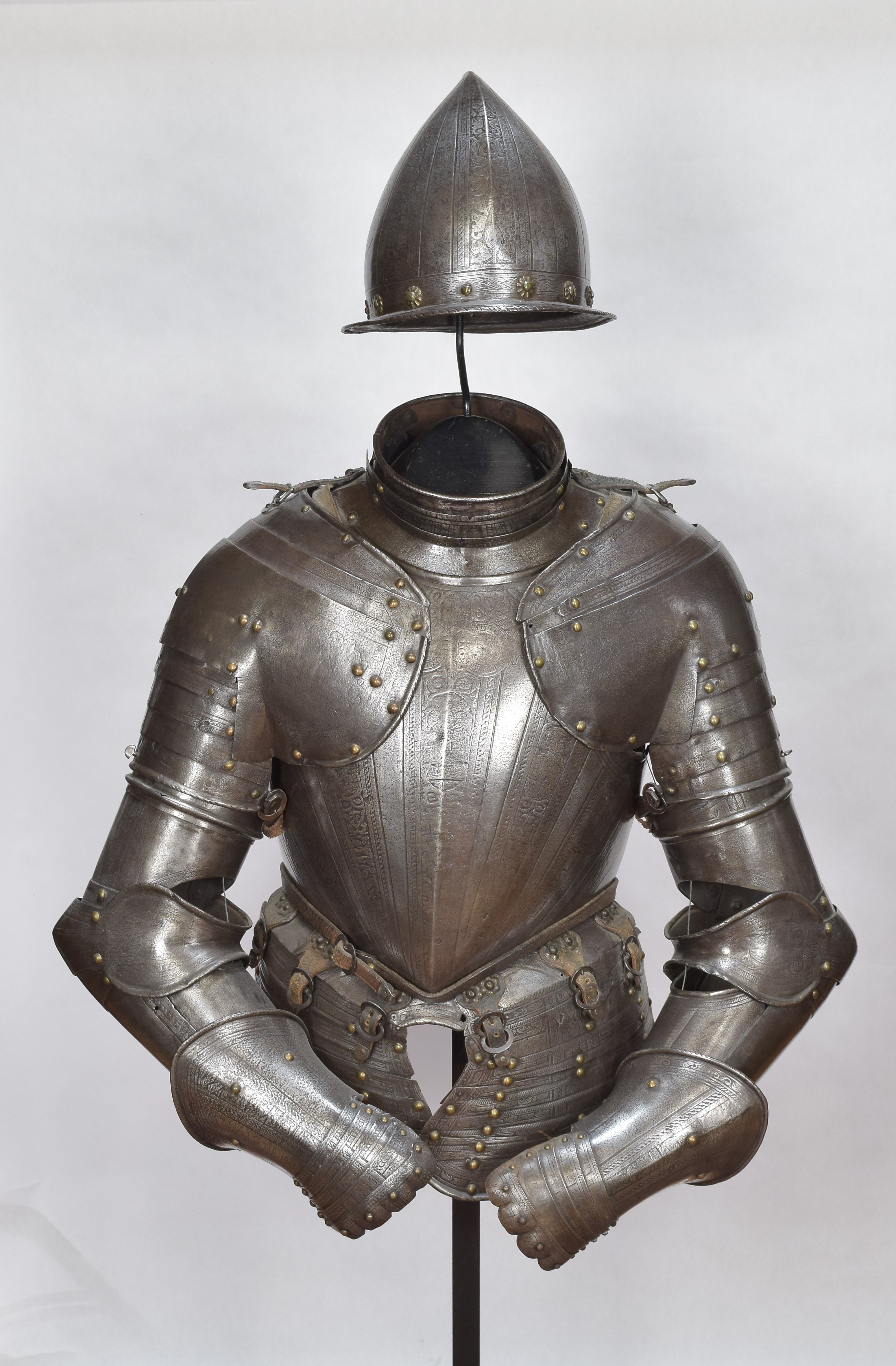
A corselet is "A light half armor worn by heavy infantry from the 1500s to the mid-17th century, usually comprised of a collar, breastplate, backplate, tassets, vambraces, gauntlets and an open helmet but no legharness; in the 17th century, arm defenses were usually not included." (The Complete Encyclopedia of Arms and Weapons" ed. Tarassuck & Blair). These illustrate late 16th century and early 17th century armors that would be identified as corselets. They also illustrate the difference between a "whit" and "black" armor.
 .
.
 .
.
 .
.
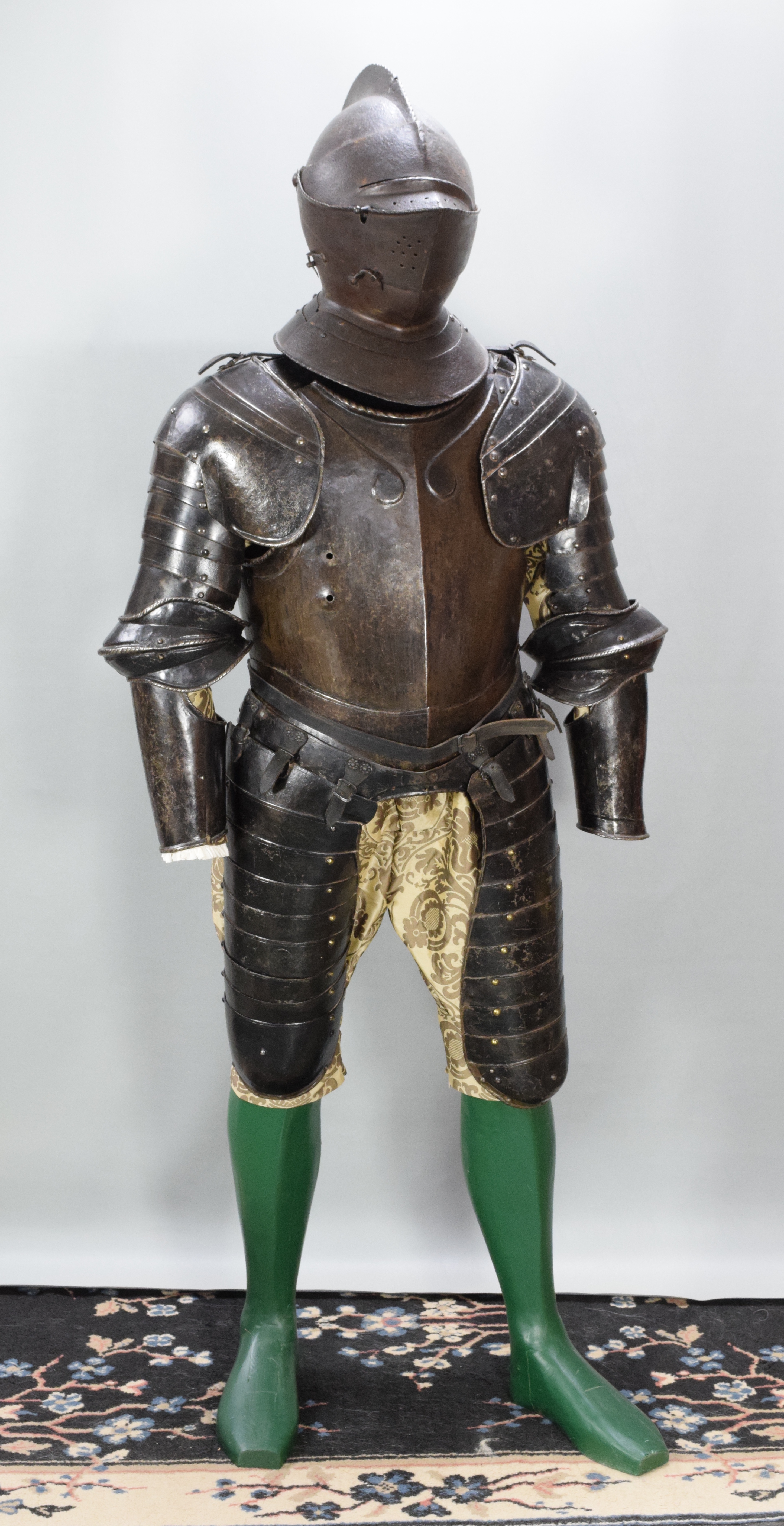
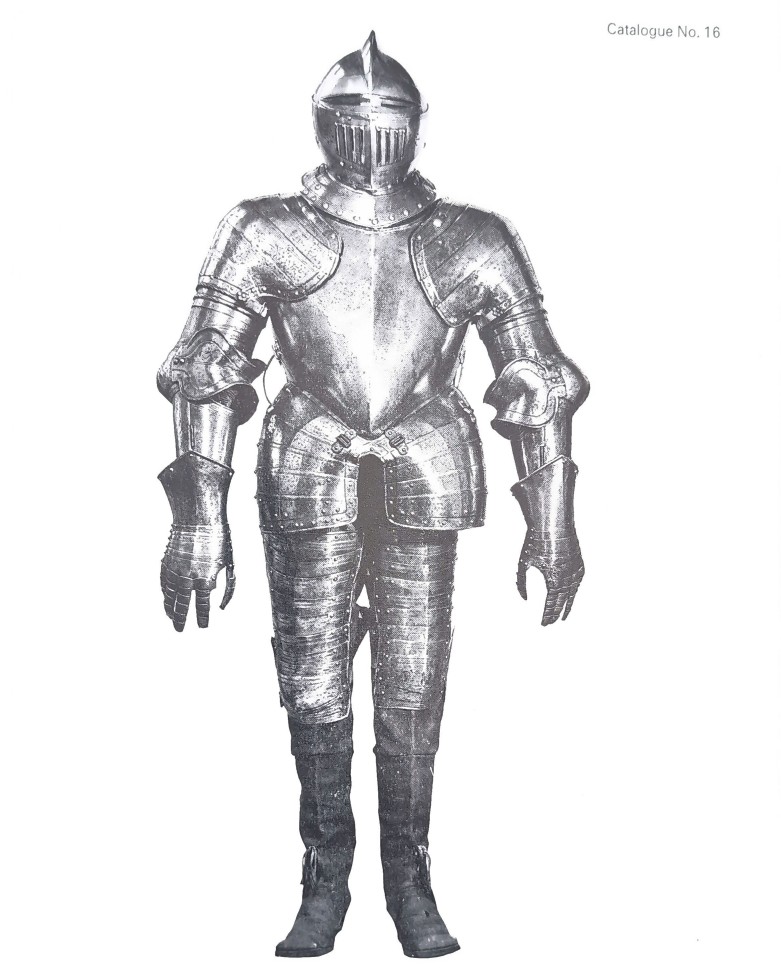
The last major type of armor described in the inventory is "horseman's", often also described as complete. The use of the term "complete" tells us that the armors must have included breast, back, collar, helmet and arms. But for a horseman, we can probably assume more. Through most of the 16th century a horseman would have worn a full armor, covering head to toe and with a closed helmet. Light cavalry could omit the armor below the knees, wearing what we tend to call a three-quarter armor. By the end of the century a heavy, full armor might have been full, or three-quarter.
 .
.
 .
.
 .
.
 .
.
One of the horseman's armors is probably a lot nicer than the others. It is described as "edged with black velvet & silver lace" and it includes a placket. The black velvet and silver lace is probably a description of the decorative fabric that extends from underneath the edges of overlapping pieces like pauldrons, tassets, gauntlet cuffs, etc. that was fashionable in the second half of the 16th c. I assume that what is being described is velvet with silver thread embroidered decoration. A basic leather strip at these locations is very practical - it prevents plates from rubbing on each other and eliminates a lot of the noise that would happen when armor parts rub or hit each other. Adding velvet and lace takes the practical strip to another level - decoration that would only be present on higher end armors.
The "placket" is a reinforcing breastplate that attaches over the breastplate. This allowed the armor to be built to be proof against the more powerful guns in use in the late 16th c. but also wear the armor in a lighter configuration to save weight. These are not found on low end or munition armors. This type of customization is another indication of a higher end armor.
The picture bellow and leftmost image above show very stylish horseman's armors from 1587 and 1585-90. They were made at the Greenwich armoury. The one above is a plain armor, the lowest level of decoration possible. The one below is somewhat nicer adding narrow bands of etched decoration. The rightmost image above shows what a nice three quarter horseman's armour could look like near the end of the 16th century. It has tassets and separarate cuisses, but it would never have included greaves.
 .
.
Lionel Tollemache JP and sheriff of Suffolk would have wanted to own as fashionable armor as he could to demonstrate his wealth and status. I have not seen any indication that the Lord Tollemache had a license to obtain an armor from the Greenwich armoury, so my initial assumption would be to assume that his armor would have been similar, but from another source. Later I will point to the reinforcing breastplate which was sold from Helmingham Hall that is now described as Greenwich in the RA catalogue entry. This indicates that my assumption may be wrong. This is supported by the survival of parts of a suit that is now in the National Museum of Scotland in Edinburgh. It is described as being of Greenwich manufacture and it seems to have come from the Tollemache, and so was likely originally at Helmingham Hall. It is currently dated to "c. 1600." This armour can be found here. Unfortunately, it is not illustrated in the online museum catalogue. This armour was described by Vesey Norman in the 1972 "Arms and Armour in the Royal Scottish Museum." The original parts are the pauldrons, arms, tassets and gauntlets. These have been completed with lower quality helmet and breastplate in its current configuation, almost certainly after its working life. Looking at the surviving parts, it really does appear that these are likely of Greenwich manufacture.
The wording is very different between the inventories, but we can find a reasonable correlation between items. I think that is is reasonable to match the "vij almon ryvets" with the "vij olde fashioned foote armes use in the time when they hadd arrowes."
The rest of the armor still seems to be present in the inventory, though there has been no attempt to align the entries directly. We still have a total of 6 full horseman's armors - 5 listed together as the second entry, and another in cotton cases and bags. The inventory doesn't describe the velvet and silver borders, but it does describe it as the "beste horse armes" and it includes a separately listed "stele brestplate" which would correspond to the previously listed placket. It is interesting to note the use of "stele" in the description of the separate breastplate. We can't be certain of the accuracy of these things, but a really high end late 16th c. armor would have been made of steel and the best pieces were hardened and tempered. This may be a reference to this quality of construction.
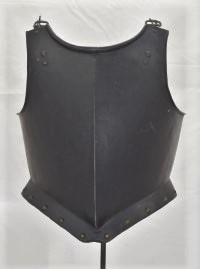
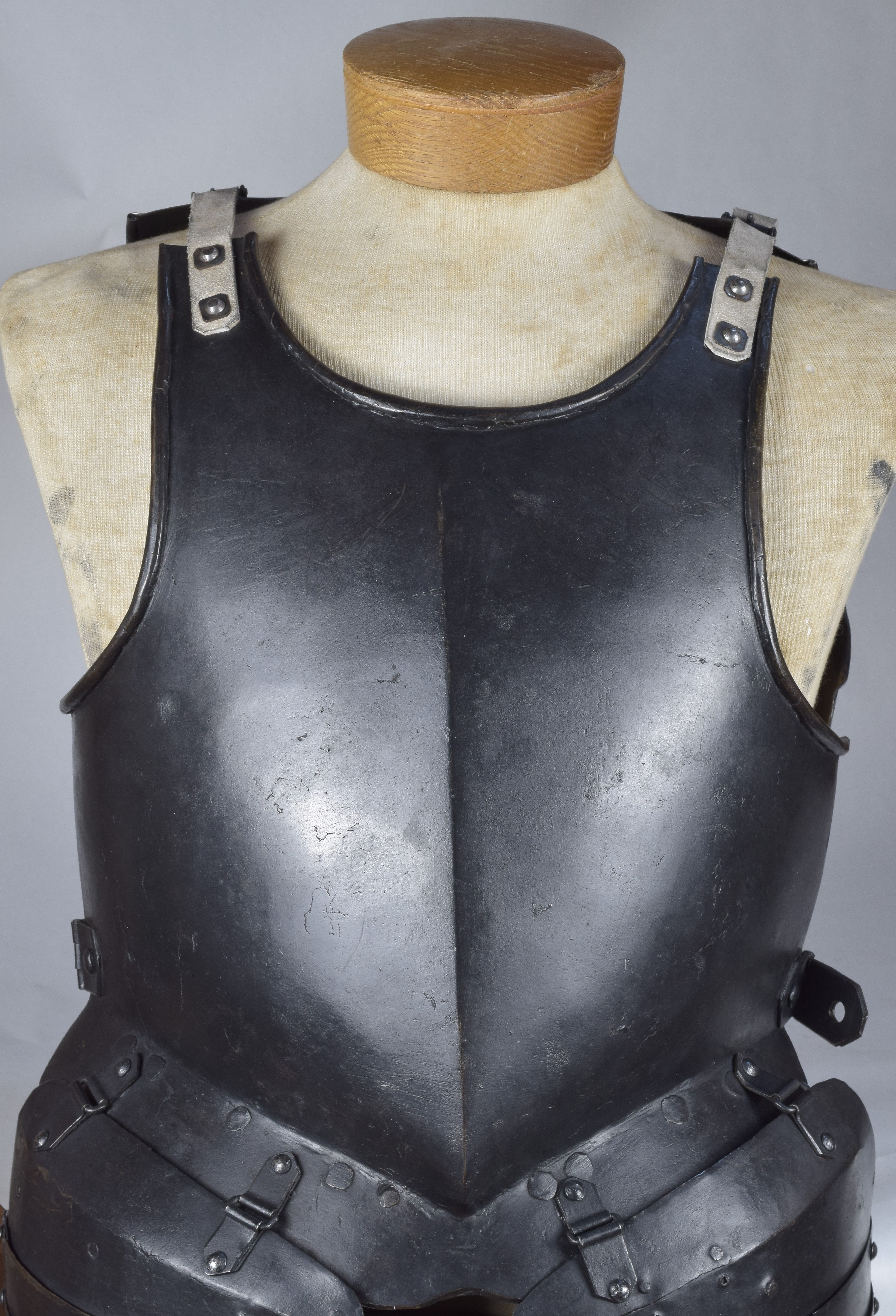
We also see that the 8 corslitts are still listed, but now they are also described as old. This would imply that they are of a style that might have felt a little out of date, but not "old" in 1597, but fashion has changed enough by 1626 that they are now considered old. This might be because they include full arms - during the 17th. century the normal meaning of a corselet changed - in the 16th c. they generally included arms, in the 17th, not. Or the style of the whole armor might have made it feel a lot older in 1626. There are styles of cuirass which would definitely be more out of place - generally they would have higher pointed bellies, or longer torsos.
The fact that the corselets have gained the "old" qualifier and the horseman's armors haven't may indicate that the horseman's armors were newer in 1597, that they were of a style that wouldn't have seemed as out of date in the early 17th century, or that a more complete armor was still seen as "up to date" for a horseman.
I think that we can reasonably assume that the armor in the armory is likely the same pieces without notable additions, losses or changes. They do seem to have found the missing "vest" after the first inventory.
The armory was entirely skipped in this inventory.
In 1741 the inventory does include the armory, but the armor seems to have very little value because the inventory for the room has been simplified to:
To summarize, the complete inventory of armor for the moated manor was 6 horseman's armors, 8 infantry armors and 7 old fashioned simple armors for use on foot. I expect that once they were purchased, the first two would have been expected to be useable, and deemed sufficient for the use of the household. In a pinch the last set could have been pressed into service.
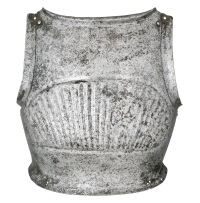
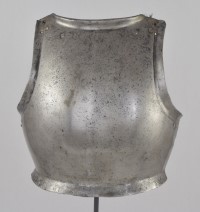
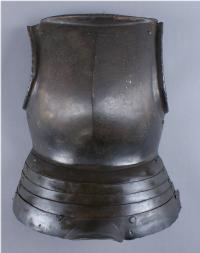
The hall was built in 1510 and the father of the person who made the first inventory died in 1575. Looking at the entries for armor and how they aged, there is a chance that a signifant portion of the armor was purchased before Lionel took ownership of the hall. He marched to Tilbury Camp in 1588 to face the Spanish on land with (reportedly) more than four thousand Suffolk men under the leadership of his stepfather, Sir Willaim Spring (ref. page xxii). The "vij almon ryvets" are an interesting survival. We don't know exactly what they looked like, but they were at least 60 years out of date (and they could be 80+ years old) by the time of the first inventory. Their style must have been distinct enough from "modern" armor by 1597 that a casual observer would have noted their age. By 1626 they aren't just old, they are being thought of as part of a time where war was fought with bows and arrows instead of guns. This is an exaggeration, there were plenty of guns on the battlefield in the early 16th c. but it points out how totally archaic these things seemed. The characteristic arms weren't really all that similar to anything current when either inventory was taken, but the breastplates would have been utterly out of fashion. So much so that they are dismissed (in different ways) in both inventories as not being something that either really thinks of as armor to their eyes. This can be illustrated by looking at breastplates that might have formed part of an almon ryvet and breastplates that would have been up to date in 1597 and 1626.
These are examples of breastplates that are found in woodcuts that illustrate almon ryvets in use and that form parts of these armors as they have been assembled in modern collections along with one from Helmingham that is now in the RA.
 .
.
 .
.
 .
.
 .
.
 .
.
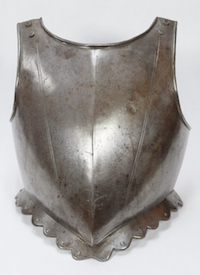
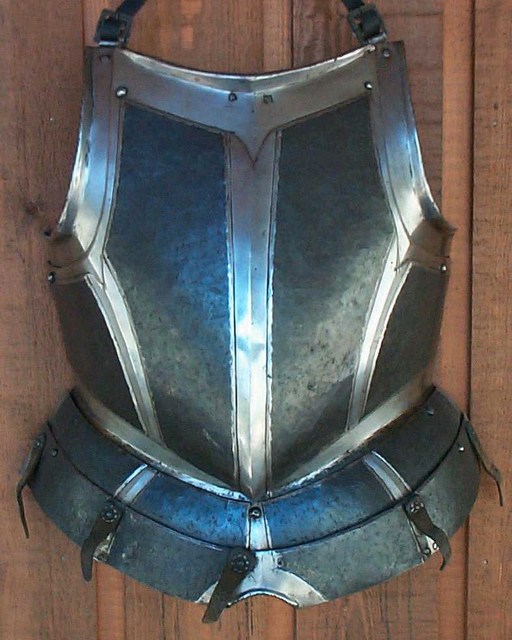
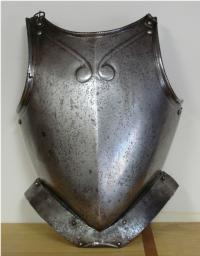
Breastplates that would have fashionable in the 1590's look like these:
 .
.
 .
.
 .
.
Breastplates that would have fashionable in the 1620's look like these:
 .
.
 .
.
 .
.
There is probably little doubt that the "almon ryvets" were purchased sometime relatively soon after the hall was built. Given the fact that the corselets have become "old" while the horseman's armors have not, and given that there were financial pressures on the family between the 1575 and 1597, it is reasonable to propose that the corselets were purchased before 1575. It is possible that the horseman's armors, or at least the best one, may have been purchased in conjunction with the service related to the Spanish Armada in 1588.
The remains of another armoury survive right up the road in Mendlesham - only 11 miles away). It includes pieces from the early 16th century, mid century and the 17th century, just like the pieces that have been in Helmingham Hall. The armory is not exensively published, but these are screen shots from a public video talking about the armory (each links to the full video):
 .
.
 .
.
The pieces on the left and right of the left hand image and the center and right of the right hand image are early 16th c. pieces that form parts of lower and higher end almon ryvets. One of the pieces that has been sold from the armory closely matches the breast on the right. The "splint" arms that have been sold from Helmingham compare very closely to the arms displayed in the middle hanging from the wall. The splints that survive from Helmingham and Mendlesham are nearly identical. One of the few known early breastplates from Helmingham also compares very closely to the breast on the right in the second image. This allows us to get a (likely) very accurate impression of the appearance of the "almon ryvets" included in the Helmingham inventory.
A few pieces of mid 16th century common armor have come out of the armory of the Earls of Pembroke at Wilton Hall. I have found what appear to be two nearly identical armors, one now in the RA (II.164), the other in the Kelvingrove (A.1976.27.a). Both of these have breastplates that look like the mid century breastplate in Mendlesham. This shows the one in the RA:
.
Since we find the same style of mid-century breastplate right up the road from Helmingham in Mendlesham and across the country and the corselets are thought of as older sooner, it might be reasonable to assume that the corselets followed this same style. I haven't seen one of these in the Helmingham items, but at least two of the backplates sold from Helmingham look like they would have been used with this style of breastplate. If the corselets did look like this, I would assume that they would have shorter tassets like those we see in the Mendlesham images, no holes for a lance rest in the breastplate (also like the Mendlesham example) and probably an open faced helmet.
The Hemingham House archivist has provided me with a copy of a modern typed inventory of the armor found in the hall. It was made by John Seymour Lucas, R.A. in October 1920. On the first page it summarizes as follows:
This listing represents a significant downsizing of the armory after the early 17th century. Some pieces have been added (see below), so that makes the losses more significant. The way the 1920 inventory identified "pieces" would lead to a corselet including 10 pieces and a horseman's armor probably 12 or 14 (if we count the "best" armour it could easily be significantly more). So 8 foot armors would have consisted of 80 pieces by themselves, and the 6 horse armors at least 72 more. If we add a minimal definition of a ryvet (7-8 pieces), we add at least 49 more parts, totalling a minimum of 201 parts. So, we have lost half of the armor that was in the house (this math isn't right, pieces were also added, so more of the original stock is lost). Honestly, this is probably very good for a a house that was continuously in use for more than 300 years while the armor served no purpose. Most armories have lost a lot more.
All of the items dated to the English Civil War or later in this final inventory would have been added after the 1626 inventory, which was the last to include any real detail. Since the comparison of the 1597 and 1626 inventories shows no (obvious) additions, it appears that the armoury may have been augmented with additional "up to date" items around the civil war. Of course these may have been added later, but it would be a somewhat odd set of items to have been added in the 19th or early 20th c. These would include 1920 inventory numbers 73 and 74 (funerary helmets likely used in the 17th c or later) and Civil War related items:
Working from the assumption that the items identified as from the 16th c. in the 1920 inventory represent what remains of the items listed in the 1597 inventory, it may be reasonable to draw the following conclusions about that armor:
There are also some interesting earlier additions - primarily the "Gothic" demi-suit (items 1-12) and the armet (item 13). These are the type of things that would have been a nice Victorian addition to an "armoury" display.
Most of the known pieces that have been removed from the Tollemache armoury were sold at 2 Christie's sales - the first in 1953, the other in 2010. Some pieces must have been sold privately or at another yet unidentified sale. Specifically, there is a composed and restored armour in the Royal Scottish Museum that includes a number of interesting parts from a Greenwich armour that came from the collection of the Lord Tollemache. It was obtained by the RSM from T. Gregory, I presume in 1955 as the inventory number is 1955.194. This armour is described by A.V.B. Norman in the 1972 catalogue of "Arms and Armour in the Royal Scottish Museum." This is the current state of the armour:
.
The original Greenwich portions of this armour include the pauldrons, arms, tassets, cuisses and gauntlets (with some restorations). These parts would have foremed parts of a good horseman's armour. It would seem that this would most likely be the best armour from the 1597 and 1626 inventories. This would imply that it was originally black or possibly blued. If that is not the case and this is one of the other 4 horseman's armours, then the Tollemache had more than one Greenwich armour. The new book on the Greenwich armors in the Metropolitan Museum of Art does say that in the late 16th and 17th c. the Greenwich armourers produced a (for them) large number of plainer armours. I guess it is possible that Lord Tollemache might have purchased a number of armours from the Greenwich armoury, but that seems unlikely. Even in the armoury of the Earls of Pembroke, Greenwich armour was special enough to be called out. Since both inventories (in their own way) identify a best armour, I will start with the assumption that this represents parts of this best armour. The description of this piece indicates that a buffe remains in Helmingham that is likely also part of this armour. If this attribution is correct, then the pieces have been cleaned to a bright (but pitted) finish since the armour was inventoried in 1597.
Several items were sold by Christie's, London, 14 May 1953. This sale included items transferred by Lord Tollemache to Peckforton Castle, Cheshire. I have found the sale catalogue. The Tollemache items are listed as lots 104 through 109. They are prefaced with:
In total, this sale included 9 breastplates, 9 backplates, 4 "English" helmets, a close helmet, 2 pairs of arms, 1 pair of gauntlets, 3 pairs of tassets, 2 pairs of cuisses and probably one pikeman's pot. We know that these can't all be listed in the 1920 inventory, since it only includes 8 breastplates and 9 are sold in this sale. If these had been listed in the 1920 inventory, it would represent 40 total items.
It would seem to be a reasonable assumption that all of the items sold in this sale were transferred from Helmingham to Pectforton before 1920 except for the last lot. So the "full" list of items that existed as part of the Helmingham armoury in the late 19th century should have been the superset of these two lists.
The most interesting item was a "composite armour" (lot 109, the last one in this list) which is probably the demi-armour (items 2-12) from the 1920 inventory, though some of the information doesn't match all that well. We can find the cuisses from this lot in the RA - the right, the left, and two rear plates. I have not yet located the other pieces of lot 109. This would imply that items 2-12 in the 1920 inventory were transferred after 1920 to Peckforton Castle, though other items must have been transferred earlier. It is also interesting to note that the Christie's description seems to indicate that the cuisses might have "gilt rosettes" in the border, though that may just be on some of the other pieces of the "suit." The cuisses in the RA do not have anything similar and don't appear to have holes that would have been used to secure them. The other pieces sold later (see below) do have rosettes on many borders. The breastplate from this "suit" appears to be listed in the 1963 exhibition of "The Art of the Armourer" at the Victoria and Albert Museum. Item number 9 is described as having been part of this lot. It is illustrated, so we can see that it is from about 1500 or just after (similar to the 1500 date provided). It is one piece (fauld missing) and has holes for a lance rest. At the time of the exibition, it was owned by Claude Blair. If this did form part of the Elizabethan armoury, it would imply that one of the horseman's armours was quite old. Since there is no mention of the armet, salade, or other high quality early pieces, it seems that this "suit" was most likely added to the collection after the original inventories, so the initial assumptions about the dates of the original inventory items seems to be valid. I have not yet found where the rest of this "suit" may have gone after the sale.The sale also included a pikeman's armor which (at least in part) appears to now be in the RA (III.1298). The information listed in the RA online catalogue indicates that RA III.1298 is a breastplate that was part of Lot 107 from this sale. Which corresponds nicely with the description in the catalogue - the RA item does have "V" shaped flutes. I guess the rest of the half armor has been separated. I do not see this in the 1920 inventory, so it was likely transferred later. In the description for RA III.1298 the notes indicate that "The Peckforton armor was transferred from the family seat at Helmingham Hall, Suffolk." The RA page for this breastplate can be found here.
Since the breastplates and backplates listed are described as having roped borders, and the only surviving early breasts and backs from this collection for which we have pictures don't have roping, we should assume that these were parts of either the corselets or the horseman's armors. Six breasts and backs plus one good suit, plus the parts that were listed in the 1920 inventory (counting the breastplates) brings us up to a total of 6+1+3=10 breasts and backs surviving from the original 14 armors. That is a much higher survival rate than the 1920 inventory alone suggested. The other half suit and 4 English helmets with hinged neck guards" add to the count for the 17th c. items added after the original inventories.
Christie's London held a sale on Sept. 30, 2010. It included a number of items which were identified as "Property of a Nobleman". This group of items has since been identified as coming from Helmingham Hall. So, it would be interesting to correlate the items in the sale with the items that were listed in the inventories. The items were not grouped in a way that correlates to the older inventories, but there is some interesting correlation to the 1920 inventory.
The relevant pages from the sale catalogue:
 .
.
 .
.
 .
.
 .
.
 .
.
All of this is of some specific interest to the Allen collection because it includes a few pieces purchased at the 2010 Christies's sale. These items in the collection are probably surviving elements that would have been listed in 16th and 17th c. inventories. They have been directly matched to the 1920 inventory using the description and the internal numbers in "red lead." These items include all of the mid 16th century arms and the pair of cuisses:
 .
.
 .
.
 .
.
 .
.
 .
.
 .
.
The 2010 Christie's sale represents a further downsizing of 35 items, most of which appear in the 1920 inventory. I think that at least the salade was probably a later transfer, so we likely decreased the 1920 inventory by 34.
The armor appears to fall into several age groups. These are:
Items that appear in the historic inventories include groups 2, 3 and 4. These seem to represent the contents of the "working" arsenal for the house by the end of the 16th c. Without resorting to the grossly out of date pieces, this means that they could have put a group of 6 horse and 8 foot into the field from this house. One of the horse armors was a lot nicer than the rest. It was seen as reasonable for one person (almost certainly the Lord) to dress appropriately for his standing, and dress the rest of his men with less elegant armors. Some of them would have been more up to date than others, but they wouldn't have looked totally out of place in a modern army. The Wollop inventory indicates that a lower level knight could put 1 horse (almost certainly himself), 2 foot and 3-6 more lightly armed men into the field. My assumption is that the 7 and 6 almain rivets each owned would have been considered obsolete by 1566 and 1597. They would only have been used in a real emergency.
It appears that the armor stored at Helmingham has included items which stayed in the hall and additional pieces removed to a 19th century house built by the Tollemache (Peckforton Castle). It appears that Group 1 was transferred after 1920. We must assume that the other items were transferred earlier, maybe soon after it was built between 1844 and 1850. There have been at least 2 significant sales from the collection, the first in 1953, the second in 2010. Other sales must have occured - at least the RSM "suit" found its way out of the collection without being part of either of these sales.
"Household Inventories of Helmingham Hall 1597-1741".
Suffolk Records Society Volume LXI
Boydell Press.
Woodbridge, Suffolk
2018.
"The Royal Armoury at Greenwich 1515-1649 A History of Its Technology" by Alan Williams and Anthony de Reuck
Inventory of the armoury of Helmingham Hall Oct. 1920.
Christies, Manson and Woods sale catalogue for the sale at Spencer House, 27 St. James's Place, St. James's Street S.W.1 on Thursday, May 14, 1953 at 11:00 AM.
Christies sale catalogue for the sale at South Kensington, 85 Old Brompton Rd, London SW7 3LD on Thursday 30 Sept. 2010 at 10:30 AM.
Royal Armouries online catalogue - royalarmouries.org
Online catalogue of the Allen collection - european-armour.com
J. F. Hayward - The armoury of the first Earl of Pembroke, Connoiseur April 1964
The Mendlesham Armoury Research Project - Mendlesham Armoury Revisted - Revelations from the Parish Archives
Inventory of the Pembroke Armoury at Wilton House, 13 December 1558
The Arms and Armour Society, The Art of the Armourer An Exhibition of Armour, Swords and Firearms. A catalogue of the exhibition at the Victoria and Albert Museum, London 19th April - 5th May, 1963.
Arms and Armour in the Royal Scottish Museum, A.V.B. Norman, Edinburgh 1972.
Gothic: Art for England, 1400-1547, 2003.
Thanks for Ninya Mikhaila for presenting her work related to the armour contained in inventories and inspring the project. Thanks to Simon Metcalf for providing references to the Victoria and Albert exhibitions and the RSM harness. Thanks to Tobias Capwell for the illustration of the sallet from Helmingham.