The "suit" overall to provide context. It's a nice looking suit, at least partially set up for the joust.
The museum label.
The view over the right arm. Showing the partial right pauldron - it is a full pauldron in the back but it does not extend over the breastplate. This is common when an armour is set up for the joust. The lance rest is removeable and adjustable. We also get a nice view of the arm and gauntlet and good details of the etched decoration. The jousting shield/shoulder reinforce is displayed away from the armour. It should be bolted directly onto the armour, so it would be much closer in use.
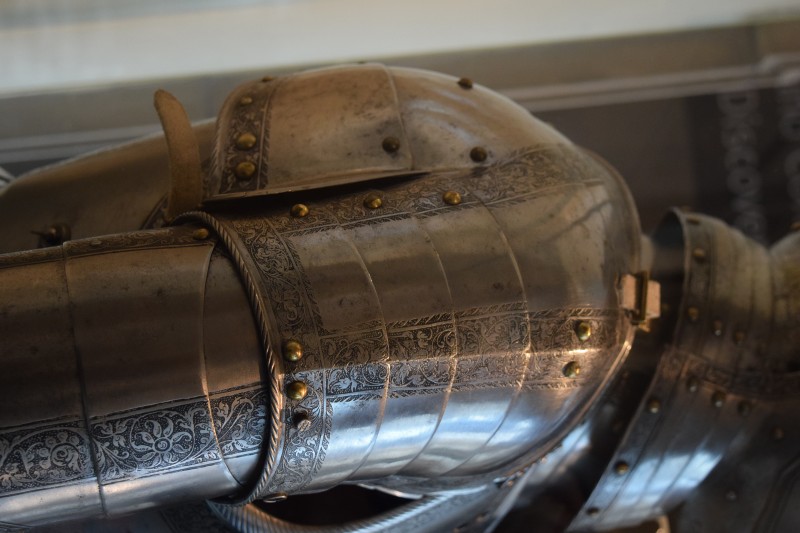
From the right side we can see more of the back of the pauldron and a good idea of the profile of the cuirass.
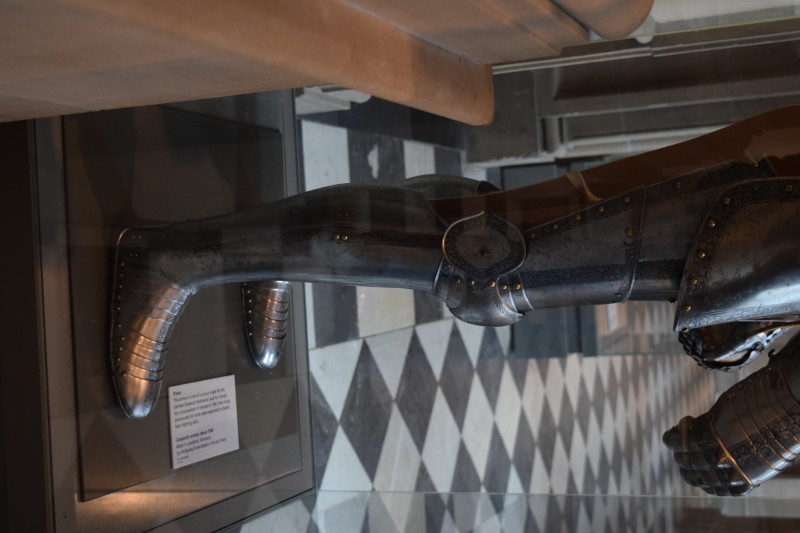
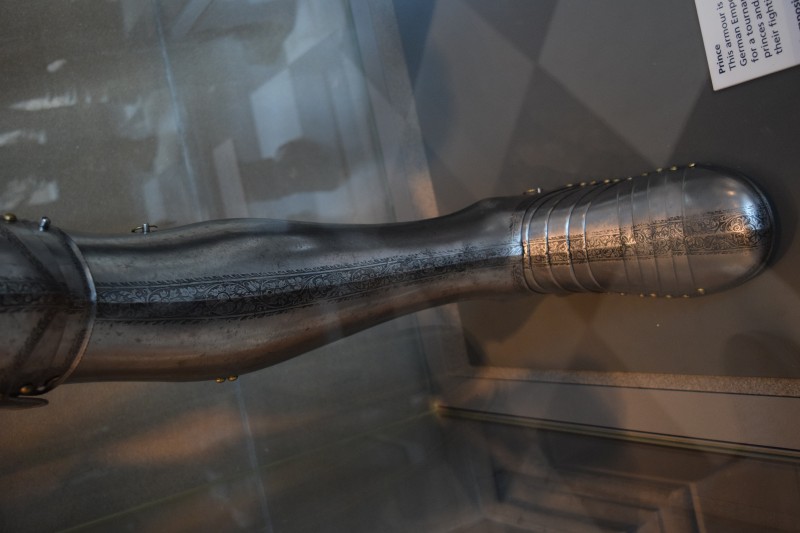
Overall view of the right leg. It has a very characteristic cuisse that can be worn long or short, knee profile and greaves with permanently attached sabatons.
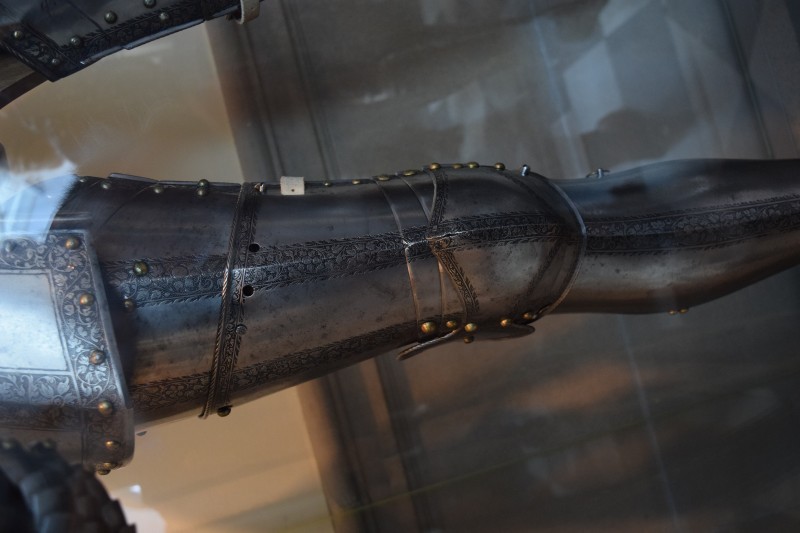
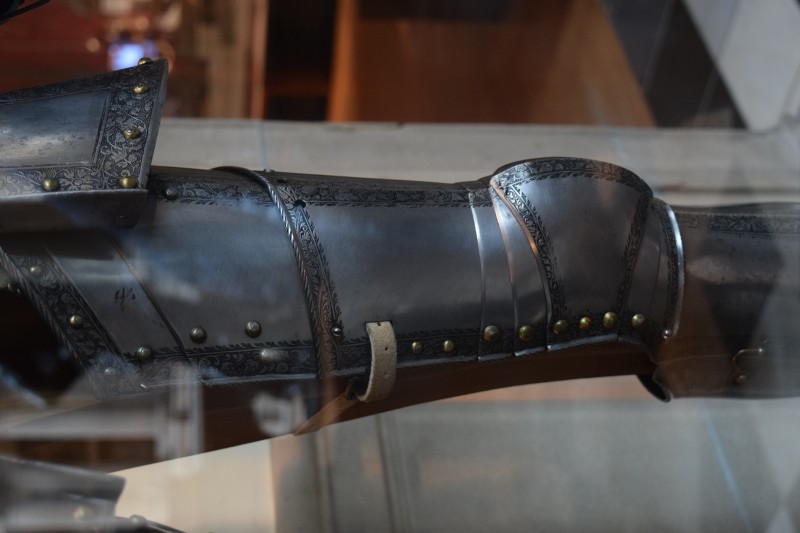
A closer view of the cuisse and knee. It includes lots of nice little construction details including the form of the rolls and how they interact at "inconvenient" places. Note the lack of roll on the side of the top plate, how the two rolls intersect at the upper corner of the lower main cuisse plate and how the rolls are executed at the point of the knee wing. We can also see how the upper and lower cuisse attach (a keyhole slot on a rivet) and the peg that keeps the upper and lower aligned. In this case it engages a third hole - there are 2 for laces. Often it engages one of the lace holes. We can also see the nearly flat center of the cop. This is not typical, except for a short time period in the late 16th c. on pieces of south German manufacture.
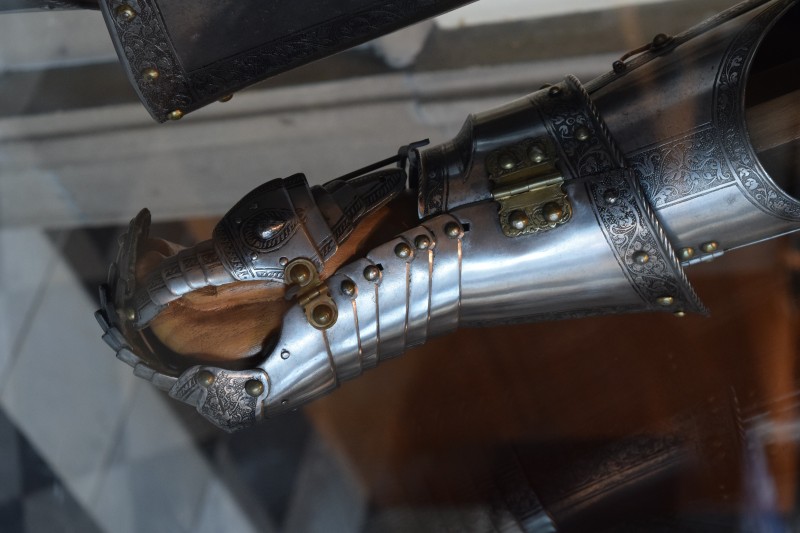
The right gauntlet. This illustrates a nice form in the cuff and back of hand. The cuff fits relatively closely, but has a nice elegant flare. The back of hand is contoured to fit the anatomy of the hand, something that is often lacking in Victorian copies.
The shoulder has a threaded mount on the lower lame to secure a jousting reinforce. The upper canon of the arm is closed, has what appears to be a single articulated upper lame (there could be another lame we can't see) and an internal rotating collar. We can also just see the end of the steel shoulder strap connecting the breast and backplate. It engages a pin on the breastplate through one of several holes. This is secured by a pin (currently, it was likely a cotter pin originally).
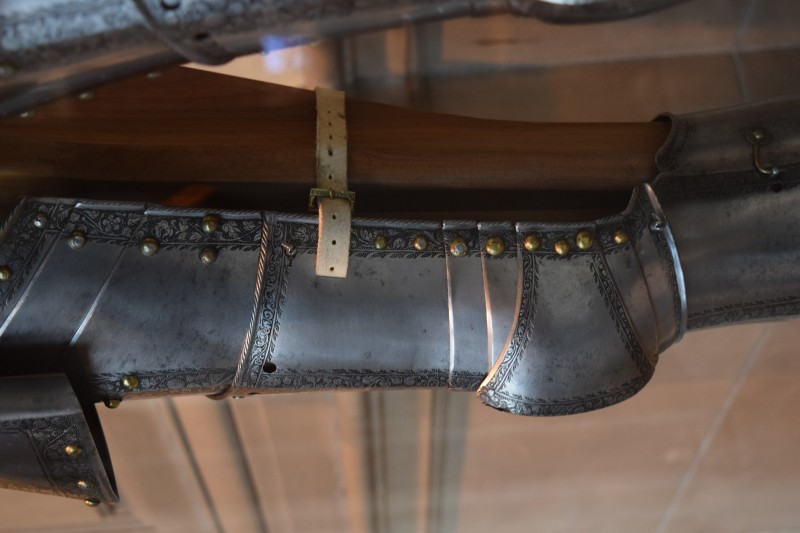
The inside of the right cuisse. We can see the internally mounted buckle for the strap around the thigh, the slot which allows the end of the strap to be tucked away neatly and the mechanism used on the cuisse to connect the upper and lower plates. In this case it is a small turn pin that engages in a small keyhole slot. This keeps the plates aligned and prevents the larger keyhole and rivet system used on the lateral side of the cuisse from disengaging. The same system is used to secure the lowest lame of the polyene to the greave. The greave is closed by a pin in the rear plate engaging a hole in the front plate - enhanced here by a hook that goes through a hole in the pin to prevent the plates from popping open.
The full view of the medial side of the right greave shows both pins securing the front to the back plates. Each has a pair of holes to allow the greave to be adjusted slightly for larger or smaller legs.
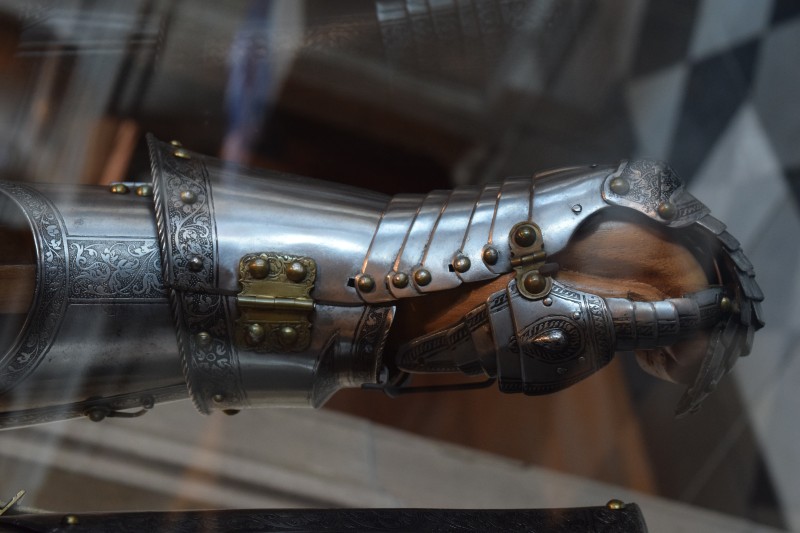
The left gauntlet fron the thumb side. Note the boxed inner cuff plate, hinged inner and outer cuff plate join and slots in the holes connecting the metacarpal lames. These slots are typical in late 15th c. German gauntlets, but they are not common in 16th c. gauntlets.
These images were taken during a study session of a few pieces in storage at the Kelvingrove Museum Glasgow in May 2026.
These images are available for study purposes only. They are provided with kind permission of the Kelvingrove Museum Glasgow . Any request for reproduction or commercial rights should be directed to the Kelvingrove Museum Glasgow . Issues with photography are the fault of the photographer, Wade Allen, and not in any way the fault of the Kelvingrove Museum Glasgow .
If you have any questions, please send them to Wade Allen
This site last updated Fri Jun 12 10:44:56 EDT 2026