
Almain collar circa 1540
Three plates front and rear. Upper plates with inward turned, roped border at the neck (turn at least somewhat of jelly-roll form and fine very angular roping), secured by an integral hinge on the left and pin on the right (there are two holes on the right side, the top one secured to the rear plate and engaging the hole in the front plate). Main front and rear plates with triple raised lines curving up to a central point. Originally part of an almain collar, right side with a turning hook to secure the leather for the right shoulder. Cleaned and re-blacked. Together with (detached) shoulder defense for the left shoulder of 6 plates. The lower plate with an inward turned ropped roll, buckle and raised flutes ensuite with the main plates. All aparently originally finished bright. Collar cleaned, re-leathered and with modern blackened finish. Shoulder cleaned and preserved but not restored. Remains of old leather at the front and center. The center of the front of the gorget and the shoulder creased, edges beveled and notched at the center. Buckle mounted to the front of the lower shoulder plate with a decorated plate. There is a slot behind the buckle which was probably used to secure the end of the strap. The shoulder plates of typical form - the top plate basically flat, the next dished more than the others, the next 3 lightly dished. The bottom plate slightly dished in the back half. The current shape of the shoulder is curled up due to deformation of the old leathers. This does mean that it illustrates how the arm could bend forward in use. From the Armoury of the Princely House of Hohenlohe-Langenburg, removed from Schloss Langenburg. Painted on the inside of the front and back plates of the gorget with inventory number 444. [inv. num. A-247]
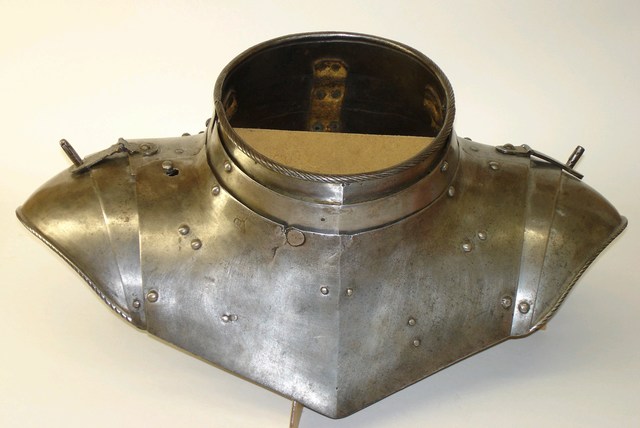
German Gorget circa 1550
Formed of 3 plates front and back with additional plates covering the points of the shoulders. Main front plate with central crease. Main rear plate formed to the shape of the neck and shoulders. Neck tof two lames front and back. Upper plates with strong inward-turned roped rolls. Neck lames creased at the center front following the crease in the main plate. Neck lames attached by 3 leathers front and back, each secured by 2 rivets in each plate. Upper plate secured by an integral hinge at the left and a pin at the right. Main plates secured by a pin at the left and a pin engaging in a keyhole slot at the right. Attached shoulder protection of two plates each. One a small articulating plate, the other shaped to cover the point of the shoulder. Edge rolled and roped. Secured with sliding rivets at the back and leathers at the center and front edge. The leather on the right can be detached from the main plate to allow the gorget to be opened. Two hinged mounts for the suspension of the pauldrons, each carrying a vertical pin with a spring-loaded catch. One associated. Older leathers. A pair of holes at the base of the center of the rear main plate. I have added two images of another separate pin in the collection. This one has lost its toggle, but retains its spring.
Top of neck slightly out of round. App 6 1/2 inches across on the inside (app. 1/4"""" longer front to back than side to side). The main plates are 10 1/4 inches wide at the front, 11 1/2 inches wide at the join between the front and back plates and 13 1/4 inches wide at the back. Overall thickness varies between 0.03 in. and 0.050 in. It is generally around 0.040 in. thick.""""
For similar see WAM 2014.783 - formerly in the John Woodman Higgins Armory Collection and Claude Blair - European Armour - page 207 item 150 - illustrates item II. 1 from the Royal Armouries. [inv. num. A-25]

Gorget circa 1560
South German, probably Augsburg. Of bright steel composed of 4 plates front and back. The top one with inwardly-turned and roped roll, the bottom one drawn down to a blunt point in the front. Hinged on the left side with an integral hinge in the top collar plate and a rivet in the main plates. Secured by a rivet on the rear plate engaging a keyhole in the front plate and two pins engaging holes in the upper plate on the right. Two pins are relatively rare. This may be to keep the upper plates aligned perfectly if the collar is meant to engage a roll on the bottom of the helmet. The upper one is secured to the rear plate and engages a hole in the front plate, the lower one is secured to the front plate and engages a hole in the rear plate. The top corners of the second rear plate are notched to allow the gorget to open, the plates to fit nicely and still allow for an overlap. With brass-capped rivets throughout. The rivets that secure the straps for the pauldrons are modern. The other rivets may be original, which would make the leathers original. Possibly some form of mark on the main front plate. Very nice form with tapering neck plates. The gorget includes two straps for securing the pauldrons which appear to be later replacements. Details of the contruction including the difference in thickness between the front and back plates, the double pins, beveled edges, inset hinge, brass capped rivet heads and finished edges of the inner plates indicate this likely formed part of a high quality armour. This is very similar to the gorget on Wallace A45 catalogued as A45.02 and WAM 2014.1175.2 formerly in the John Woodman Higgins Armory Collection. The leathers are old and collapsed so the images do not show the plates sitting as they should. The gorget should be much taller.
Ex. Coll. Peter Parsons (2011), Robin Wigington (1977), Part of a South German armour sold by Sotheby , Co. London 12 Feb. 1974, lot 172.
10 3/4 in wide at the back, 8 3/4 in wide at the front. Thickness varies on the front main plate between 0.070 in. and 0.095 in. It is generally in the 0.080 in. range. The main rear plate is thinner - 0.040 in. to 0.055 in, mostly .040-050.
Weight: 2 pounds 8 ounces (1,130 g) [inv. num. A-201]
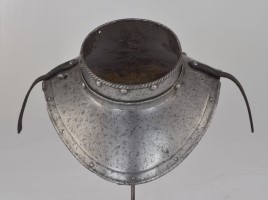
Italian Gorget circa 1580
Gorget of two main plates with single neck-lames at the front and rear. The outer edges of the main plates are bordered by a half roll and recessed border, the half roll roped. The neck edge of the main plates with matching roped half-rolls. The neck plates with roped full rolls. The neck plates are secured by an internal hinge at the left and a pin in the rear plate engaging a hole in the front plate on the right. The main plates are secured by a turning hook on the right which engages in a keyhole slot. Very similar to that on Corselet II.47 in the Royal Armouries (illustrated on plate LIX in European Armour in the Tower of London). Displayed as part of item number A-114.
Measurements: Top of collar 6 in. wide and 6 3/16 in front to back. 11 1/4 in. wide at the widest part of the back. Thickess of the main plate generally .030-.040, the collar plate .020-.030. Weight 1 pound 9.6 ounces (725g). [inv. num. A-114c]
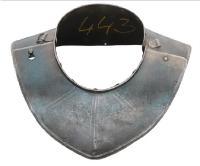
Pikeman's Gorget circa 1620
Of single hinged plate front and rear, secured by a rivet on the left side and a keyhole slot engaging a rivet on the right. Low collar with a very narrow outward turned roll and hollow roll at the outer edge. Lining rivets with flush outer heads along the lower edge and along the neck. Decorated with light incised lines. Cleaned and re-blackened. From the Armoury of the Princely House of Hohenlohe-Langenburg, removed from Schloss Langenburg. Painted on the inside with inventory number 443. [inv. num. A-245]

Gorget early 17th c.
German. One piece front and back with integral raised collar. The front plate with a shallow crease at the center, the rear shaped to the shoulders and neck. Plates secured by a pivot rivet on the left shoulder and a large keyhole engaging a broad headed rivet at the right. Neck and outer edge with plain inward turns bordered by round head lining rivets with round internal washers securing a lining band. Many of these washers incomplete - they appear to have been punched to close to the next washer, so they have rounded cut outs. Band around the outer edge nearly complete. More loss from the band at the neck. The ends of the rolls on the rear plate crudely flattened at the edges to allow for the overlap of the front plate. Finish appears to be an old very rough "white" finish which shows significant pitting in some areas. Various areas of delamination. The front plate is marked with round center punch like marks. Three of these define the neck line, one at each end and one in the center. There is a fourth mark that defines the center line. There is one similar dot at the bottom center of the back. This is likely a minimal example of a gorget designed for wear without a breastplate. The most aggressive form of this style is illustrated by item number A-261. [inv. num. A-289]

Cabasset circa 1590
Tall form, small stalk, narrow down turned brim. A line of 14 iron lining rivets (replaced) near the base of the skull. Two rivets at the back above the line of lining rivets likely formerly to secure a plume holder. Delaminations in the skull some of which have grown to form holes near the point. Apparent smooth finish with old oxide and browning varnish. Brim with a plain inward turned roll with a narrow recess.
Measurements: 7 3/4 in. tall brim 9 1/4 in. wide and 10 in. long. Weight 2 pounds 4.8 ounces (1045g). Thickness: varies significantly in the lower half that is easy to measure. Mostly .05-.06 in. but some areas as thin as .04 in. and some thicker areas up to .07. There seems to be little pattern to the variation. [inv. num. A-295]

Western European Cabasset circa 1600
Rounded bowl formed in one piece rising to a slight point at the center of the top. Creased along the center and with a small stalk bent backwards at the point. Narrow brim slightly down turned. Brim with inward turn and narrow recess at the edge. Bottom of the helmet bowl with holes for lining rivets. 14 holes. Helmet 7 1/4 inches tall. Inside of bowl 7 inches wide and 8 1/4 inches long. Brim app. 1 inch wide at the sides and app. 1 1/4 inches wide at the front and back point. Acid cleaned. All lining rivets missing. Originally smooth finish. The Royal Armouries bought one of this same series - IV.2018. It is marked with the purported Barberini mark, unlike this one which is unmarked. One of a very large series of morions from a hoard which were sold through Wallis and Wallis in small numbers from 1978 to 2003. The first such example appears to be 26-8 June 1978 lot 1354. This one sold 17 July 1996. [inv. num. A-11]
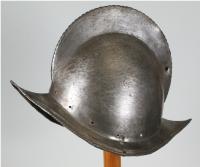
Morion Late 16th c.
One piece morion. High crest. Typical brim rising to a point at the front and back. Edge of the brim rolled and roped. Top of the crest roped to match. Holes for lining and plume holder. There is a later hole in the crest and there are 2 patches - one small one in the crest and one larger one on the bottom of the bowl. Both are old and possibly working life patches. They are formed to the relevant portion of the helmet and have tapered edges to minimize catching. They are riveted to the bowl with a number of rivets which are filed flush on the outside, minimizing the look of the repair. Inspection of the surface shows that the surface appears to be nearly original, showing a typical set of rough grinding marks in the finish. This finish would have been polished, but not as well as the original finish on item number A-184. This is a nice example of a lower quality, but still polished finish. We also see two marks, one on each side of the forhead. One appears to be square, the other forming a small cross. These appear to be marks that would occur from square section weapon impacts. [inv. num. A-67]

Morion early 17th c.
German. Two piece skull with high comb. Bowl decorated with large fleur de lys. Upturned brim swept up to points front and rear. Fleur and comb bright against a blackened rough from the hammer surface. Edges formed with notched inward turns. Lining rivets with copper alloy decorative washers.
Measurements: Weight 2 pounds 13.1 ounces (1335g), Thickness of the rough (black) areas including the paint generally .040-.060 in. with some areas getting up to the 070-.080 in. range. The polished areas a little thinner - mostly .030-.040 in with some parts slightly thicker. [inv. num. A-286]

Burgonet circa 1580-90
Burgonet. 2 piece skull with origninally smooth surface. Extremely high, rear-swept comb. Pointed brim and tail integral to the bowl, each with rolled, roped and recessed borders. Small, original cheek plates with rolled, roped and recessed borders. The form of the bowl is remeniscent of morions at the time with aggressively pointed brow and neck. Shows signs of significant pitting and later cleaning. Rivets and decorative washers replaced. There seem to be some signs of likely original deep scratches from the cleanup of the piece at the back next to the crease and at the base of the comb.
Weight: 3 pounds 5.2 ounces (1510g). Thickness generally .030-040, some areas a little thicker. [inv. num. A-105]

Burgonet circa 1600
Augsburg. One piece skull with high angled comb and integral peak. Single neck lame and a pair of cheek plates. Rough from the hammer. Point of the peak with two marks, one the Augsburg pinecone, the other indistinct. The edge of the peak formed with a simple inward turned roll coming to a blunt point at the center and with a central crease. Neck plate with plain inward turn at the outer edge coming to a blunt point and with a pair of holes near the point for suspension in an arsenal. Cheek plates with a simple bump at the face, inward turned roll at the bottom and pierced with five holes over the ear. Retains lining rivets at the neck and forhead. Signs of delamination esp. in the rolls on the peak and neck lame and at the edge above the cheek plates which also shows signs of folds and cracking which has been repaired during manufacture.
Weight: 3 pounds 7.8 ounces (1585g).
Measurements. As one would expect, the thickness varies significantly. The bowl is mostly something around .055 in. (The front of the skull thicker, areas up to .078 and one area above the right cheek plate .090., thins toward the base of the brim to .035-.045, brim .029-.070 generally thinner in the middle, the lower back of the skull .020-.037, seemingly intentionally thinner), The tail plate .035-.055, the cheek plates mostly about .035 in. (varying between .028 and .044) The cheek plate does not get thinner as you approach the bottom of the flare, so the bottom of the cheek plate is not formed by a simple flare. [inv. num. A-276]
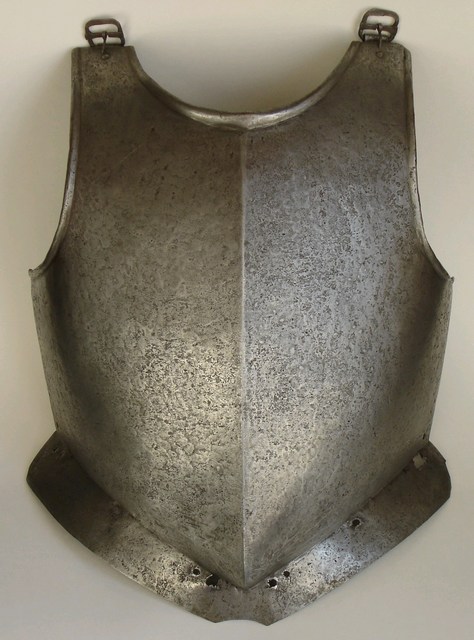
German/Austrian (possibly Gratz) Breastplate circa 1590
Including 2 buckles at shoulders. Rolled edges at arm holes and neck, full flare at waist - used without any fauld lames. Simple peascod shape. This breastplate is relatively light and most likely sword proof and not shot proof. This item is very similar to large numbers of breastplates in the Arsenal in Graz. Its original blackened finish has been removed by cleaning with acid. Originally it would have been used with a pair of tassets suspended directly from the wide flare at the waist of the breastplate - taking the place of the fauld. The holes for the tasset straps are evident. Each tasset would have been suspended by 3 straps and buckles - the ones nearest the edge and center of the breastplate were attached by 2 rivets, the central one with a single rivet. Weight 3.5 lbs.
rough inner and outer surfaces, but roughly .050-.060 inch thick overall. [inv. num. A-15]
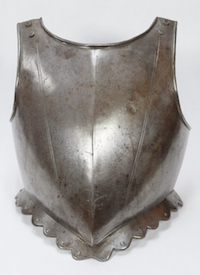
Breastplate circa 1590
Breastplate. Shot-proof breast made for use without fauld or tassets. Good, full peascod form. Heavy weight. Simple outward rolls a the neck and arms with some signs of roping. The material is thick enough that a simple narrow outward fold has been shaped to look like the more usual roll. Scalloped waist flare. Pairs of incised lines. A nice heavy, shot proof breastplate. Jonathan Tavares, curator of arms and armour at the Art Institute of Chicago indicated that this appears to be one of a set of pieces most likely of Flemish manufacture that were used in England as lower end pieces following the ideas from the very high end Greenwich Armoury. Weight 15.5 lbs.
Height 15 1/2 in. from base to center of neck hole. 12 in. wide at the waist, 14 3/8 in. wide under the arm holes.
Thickness. Near the center, app. 1 in. from the crease the thickest point of the breastplate is .285 in. Generally the center is .220 - .260 in. Thins to .185 at the top of the shoulder extensions. Thins at the peascod to .165-.195 in. Central band forming the crease thins aggresively to .160-.195 in. Tapers to .104-.138 at the side under the arm holes.
Weight: 14 pounds 7.6 ounces (6,656 g). [inv. num. A-79]

Lot of medieval elements circa Assorted
Lot of buckles. Mainly 14th-15th century. Most retaining the plates used to mount them to the belt. Some have separate mounting plates, some have integral plates. excavated. For the most part 14th-15th cent. [inv. num. L-x9]
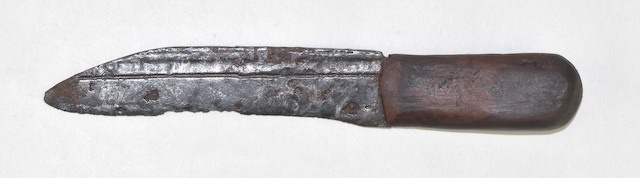
knife circa 1200
Short knife with broad and narrow blade, narrow fillet (fullering), wooden haft. c.1200. [Dordr.]. 5 in. long. [inv. num. K-105]
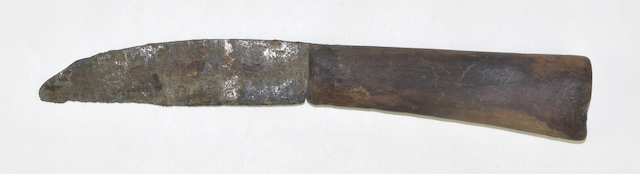
knife circa 1350
Whittle tang. One piece wooden handle. From Dordrecht. [inv. num. K-87]

knife circa 1350-1400.
Shorter knife with rectangular wooden haft and marked with two multi-pointed stars. One is still mostly filled with pewter, the other has lost its fill. [Dordrecht]. 6 1/4 in. long. [inv. num. K-107]

knife circa 1400
Bone scales. blade with curved edge and straight back. Cutler's mark - 2 stars and a crescent. [inv. num. K-2]

knife circa 1430
Small knife from the Thames, marked with copper-inlaid lozenge, wooden scales and brass tang plate. Small iron applied bolster, one side remaining. 5 in. long. [inv. num. K-132]
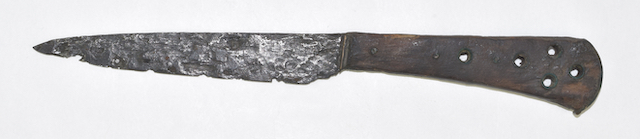
knife circa 1430
Knife. ex. River Thames. worn trefoil mark, wooden scales. 5 loops and a curved tang plate. [inv. num. K-141]

knife circa 1450
Fine knife marked with tin alloy device, wooden scales with circular pricking around rivets, tang plate. From the Thames. [inv. num. K-71]

knife circa 1480
Knife. ex. Thames at Billingsgate in the late 1980s. Flat tang with bone scales attached by three tubular rivets. The handle is inlaid with additional decorative brass inlays. The inlays alternate - two round with pairs of engraved lines (possibly bells) and two trefoils. Brass bolster plates with roped front ridge and curving up to overlap the handle scales and trefoil pommel with a line of wiggle-work decoration on each side. Stabilized blade. Ex. Coll. John Homan. 18.3cm (7.3 inches) [inv. num. K-146]

knife circa 1530
Short all-iron knife, from the Thames, marked with double crescent, with tiny trefid terminal. 5 1/4 in. long. Very similar knife illustrated at the bottom of page 110 in Cutlery For the Table. [inv. num. K-127]
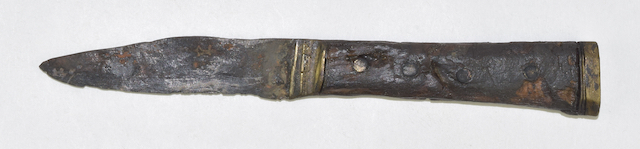
knife circa 1450
small clip point blade with wooden scale handle. brass rivets. brass bolster and pommel. [inv. num. K-95]

knife circa 1520
slim knife with latten shoulders, wooden haft decorated with rivets and twisted latten finial. [Thames]. 10 in. long. [inv. num. K-112]

knife circa 1420
small knife with copper-inlaid sickle mark, wooden scales with horned tang plate of copper alloy c.1420 From the Thames. [inv. num. K-76]
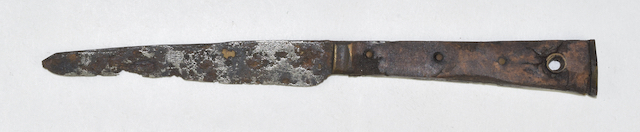
Knife circa 1400
tapered blade with full through tang. Copper alloy finial piened to the end of the tang. Handle of two rootwood scales secured by three pin rivets and with one larger hole lined with a copper alloy tube. Two piece copper alloy applied bolster. Blade marked with a gothic r. Ex. Col. Simon Moore #99.26. [inv. num. K-169]

spoon circa c. 1400.
Spoon. body and handle of pewter with an attached latten 'writhen knot' terminal. [inv. num. K-10]

spoon circa c. ??.
Spoon. body and handle of pewter. Handle broken. [inv. num. K-170]