
Items chosen for display at the Orange County Historical Museum in 2023. This was part of a larger exhibit focusing on collectors who live in Orange County.
These show the items in place in the museum exhibit.

This was the last staging before moving the items into the case for the show.


Proposed information and images to be used to describe Wade and the collection in the publication written for the exhibit.

Wade Allen blames a visit to the Tower of London when he was seven years old for his interest in armor. His imagination was sparked by the vast display of armors built for everyone from the common soldier to kings. He wanted to learn everything he could about armor. Fortunately, his father was a medievalist. Family travel allowed Wade access to books and the opportunity to visit collections around Western Europe. In the 8th grade, Wade began collecting books on armor after a personal tour of the Musee de L'Armee in Paris.

During high school while living in Milwaukee far from the major collections of armor he decided to continue the study of armor through building armor with the assistance of a best friend Aaron Toman and an understanding metal shop teacher who encouraged them. During college he could only work on armor during beaks, but he and Aaron established Valerius Armouries, turning their hobby into professional work. Wade still continues to build armor using hand tools in his little personal workshop.

When his son was a child, Wade made him a suit of armor every year as a Halloween costume.
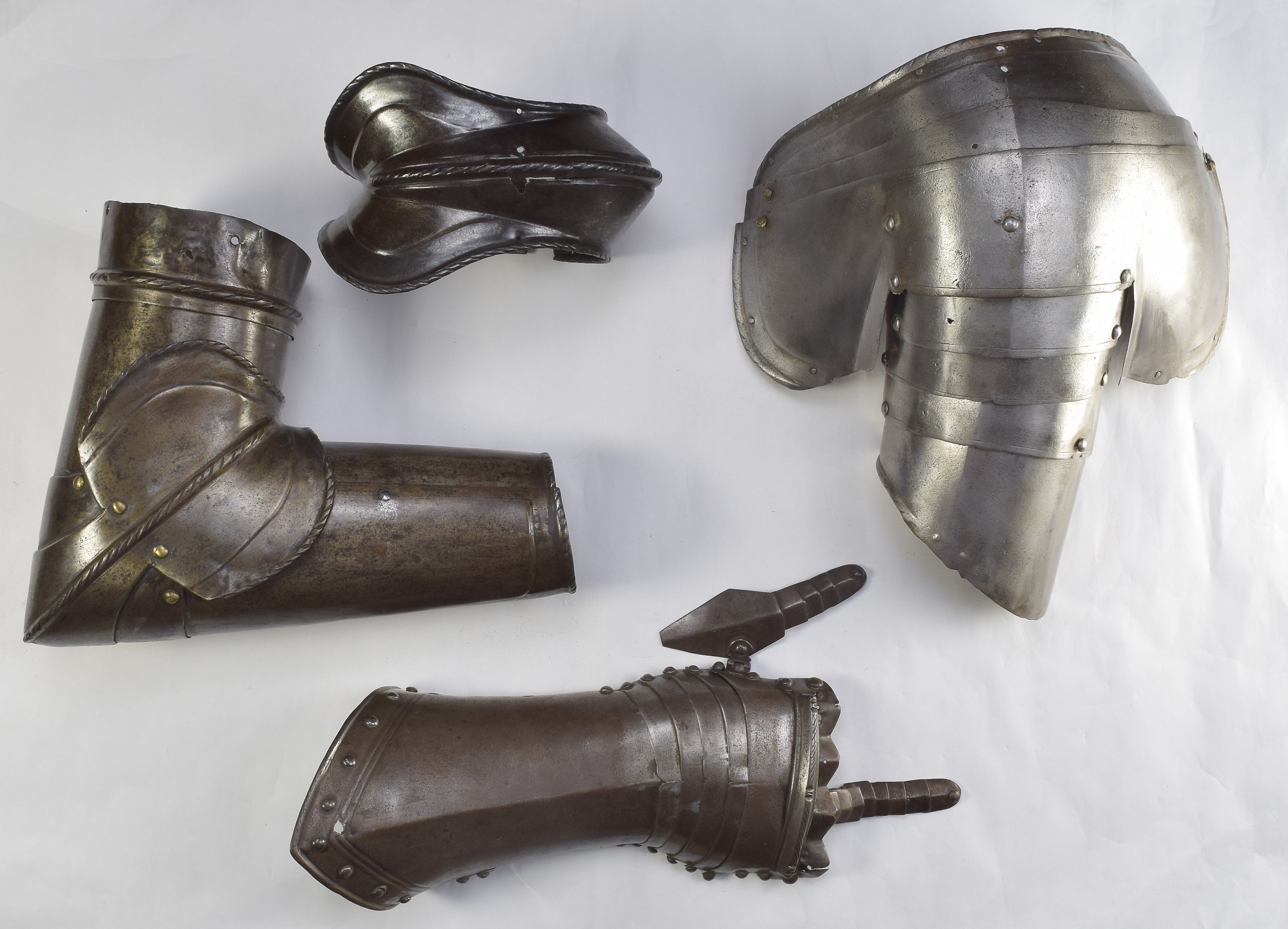
While in high school Wade purchased his first piece of historic armor to enhance the growing library and inform his construction of armor. This piece was a single elbow from the mid 16th c. By the time he graduated from college the collection had grown to 5 pieces. Building armor was a great way to learn about armor, but it did not pay well since very few people can afford to pay for the time required to make authentically shaped and functional armor. After earning a Master's degree in computer science, Wade worked for IBM for over 30 years, allowing him to build his collection. In addition to books, armor and weapons, he also owns antique spurs, knives, and miscellaneous trinkets. Now he has hundreds of items in the collection ranging from the 3rd through 19th centuries. Having grown up in a household of educators, Wade shares his collection through the internet and personal educational sessions with enthusiasts and school presentations.

For anyone interested in building a collection Wade advises "Decide what interests you and what kind of collection you want to build. Learn as much as you can through primary and secondary sources. Books and museum trips are cheaper than fakes.In my case, I am really interested in the construction, form and function of armor. This means that I look for pieces that illustrate styles and forms, and not pieces associated with specific historical figures. This broad interest means that I tend to keep more pieces than many collectors."
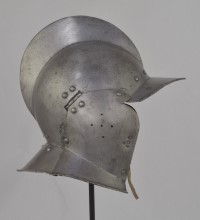 |
German Burgonet late 16th century One piece polished skull. High roped comb and integral brim. Separate neck lame and hinged cheek plates. Lower edge of the neck lame and cheek plates with inward-turned roped roll. Front edge of the cheek plates with simple turned in border. Cheek plates pierced with 5 holes over the ears in dice formation. Edges of the cheek plates and neck lame beveled. Nuremberg guild mark on the brim near the center. Right cheek plate stamped with Solothurn arsenal inventory numbers x 126. This helmet retains its original plume holder. Hinges appear to be original. Most remaining rivets appear to be original. The rivets that secure the leather loops at the chin of the cheek plates are replaced (as is the leather). The finish shows signs of areas that have rusted and cleaned, but many parts of the surface show signs of the type of scratches that are typical of old munition polished surfaces. These can be seen in large numbers in the close up images of the brim and the flare on the cheekplate. Similar, even more aggressive marks can be seen on the munions item number A-292. Provenance: Bischoff Collection, Vienna. Exhibited: Feb. 10 2023-Oct. 2023 Orange County Historical Museum Hillsborough NC [inv. num. A-5]
Three helmets illustrating different styles of helmet used in the late 16th century and two different styles of decoration. The first and third are entirely polished, the second "black and white." The background is left rough from the hammer work and black from the forging process (or painted) and the raised areas are polished in contrast. |
|
| |
 |
German Morion circa 1600 Black and white. Typical of the Munich town guard. 2 piece bowl with a high comb. Brim with prominent upturned points at the front and back. Each side embossed with a large fleur-de-lys. Provenance: Ackermann Collection, Luzerne. Weight 2 pounds 10.6 ounces (1205g). Exhibited: Feb. 10 2023-Oct. 2023 Orange County Historical Museum Hillsborough NC [inv. num. A-6]
|
|
| |
 |
Cabasset circa 1600 Normal form, small stalk, narrow down turned brim. Heavy skull. Brim marked with a shield with three elements and surmounted by a crown. The mark appears to be the arms of Pope Urban VIII (Mafeo Barberini) 1623-44. The mark would indicate that it was in his armoury. Line of lining rivets with brass decorated washers (replaced) near the base of the skull. The discussion associated with Royal Armouries item number IV.2018 indicates that a large group of these, many of which have the same mark, came through Wallis and Wallis which are associated with a hoard of these found in the cellar of a house in Ireland. The RA description disputes the association of the mark with the Barberini and dates theirs to 1585-1599. This one may or may not have gone through that source. It was obtained later without provenance back to that group. Measurements: weight 3 pounds 11.2 ounces (1680g). Thickness: Usual variation in thickness as expected. Relatively thick. Basically .09 in. to .10 in. with some areas thinning to .08 and some up to .105. Exhibited: Feb. 10 2023-Oct. 2023 Orange County Historical Museum Hillsborough NC [inv. num. A-294]
|
|
| |
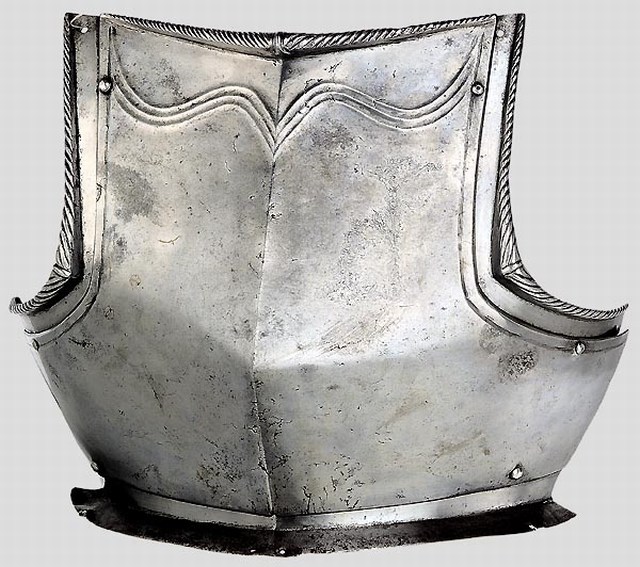 |
Lower-German Breastplate circa 1550-1560 Heavy hammered polished iron breast plate with strong projection in the medial ridge and triple extruded curved V-lines under a centrally subdivided roped flange. The left side etched (faded) with a crucifix and kneeling knight. Inset gussets with high roped turnovers. Riveted waist lame. The arm holes are bordered by a narrow recessed band. The bottom edge heavily beveled with a decorative notch at the center. The inside with distinct tool marks, the iron slightly raised in places, the double holes for the lance rest filled in the distant past. Rivets replaced. Height 12 1/2 in. (32 cm). 11 1/2 in. wide at the waist, 15 1/2 in. wide under the arm holes. 11 1/2 in. wide at the top with the gussets fully extended. Thickness on a line from the center point to the central point of the left arm roll .156 in. up to .210 app. 1 1/2 in. from the center to .170 at the corner. Along a line 1 in. up from the bottom edge from the center to the outside .160 in. at the center thinning down to .10 at the rivet securing the waist lame down to .075 near the edge. Upper half more consistent ranging somewhat randomly between .170 to .210 with a few spots reaching .230. Up at the top corner of the arm hole thining down to .120 in. Waist lame in the upper facet .132 in. near the center tapering to .055 in. at the edge 'Flair' less even and generally thinner varying between .110 in. to .045, mostly between .070 and .090 in. Overall pattern .20 thick near the center, tapering to .070 at the sides and .150 at the top. Exhibited: Feb. 10 2023-Oct. 2023 Orange County Historical Museum Hillsborough NC [inv. num. A-61]
|
|
| |
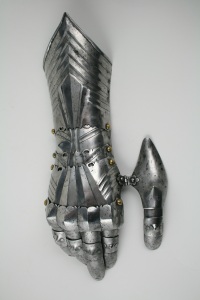 |
German Gothic Gauntlet circa 1480-90 Single gauntlet for the right hand. Nicely formed 'Gothic' gauntlet typical of the late 15th century in Germany. Fluted, engraved and pierced overall. Formed of a large metacarpal plate joined to a wrist lame by another, smaller lame. The cuff is also attached to the wrist lame. The cuff is pointed with a small outward turn. The knuckle, metacarpal, wrist and cuff plates are attached with sliding rivets allowing the wrist to flex in all directions. The knuckle plate is formed into a rounded crease over each knuckle. The base of the thumb is covered by a large plate secured to the metacarpal plate with a hinge. The thumb and fingers are covered by two plates bridged by a pointed knuckle plate that overlaps the other two plates. The finger plates are secured to a plate inside the knuckle plate. This plate is secured to the sides of the knuckle plate. Rivets replaced. Finger and thumb plates are probably also modern, but well made. Thickness: cuff generally 0.028 in (varying, .025-.032), wrist plate and next hand plate app. .030, main hand plate .030-.055 - mostly .040-.050, knuckle plate can't reasonably me measured due to the inner plate and finger plates. Weight: 13.2 ounces (375 g). Exhibited: Feb. 10 2023-Oct. 2023 Orange County Historical Museum Hillsborough NC [inv. num. A-213]
Two gauntlets illustrating very different high end gauntlets, one from the late 15th century which typifies the "gothic" style, the other from the 17th century which reflects the work of the very exclusive Greenwich Armoury. |
|
| |
 |
Gauntlet circa 1620-30 English, Almost certainly Greenwich. Cuff of flared form with a small point at the center and with a central crease. The cuff is formed of a large, shaped outer plate and a small inner plate. The inner plate is fitted with a wrist plate that extends over the base of the thumb. The end of the cuff borndered by a plain inward roll, a recessed border and two parallel engraved lines. The forward edge of the inner thumb plate with a plain inward turn and a pair of engraved lines. The back of the hand and base of the thumb covered by five metecarpal plates and a plate shaped over the knuckles. The fingers and thumb covered by pointed scales with a longer scale covering the finger tip. The edges of all of large plates bordered by pairs of engraved lines. The finger plates bordered by single engraved lines. Lining and articulation rivets capped with brass. Remains of lining leathers at the outer edge of the cuff, along the edge of the wrist/thumb plate and under the articulation rivets opposite the thumb. The back of the hand is elegantly shaped. The points at the center of the metacarpal plates and the centers of the knuckles identify this as a 17th century piece. The central crease in the cuff and metacarpal plates is curved to allow it to follow the center of the natural bend of the hand away from the thumb. The two close up images of the back of the hand show the plates (almost) fully collapsed and fully extended. Measurements: Weight: 1 pound 6.8 ounces (650g). Exhibited: Feb. 10 2023-Oct. 2023 Orange County Historical Museum Hillsborough NC [inv. num. A-227]
|
|
| |
 |
South-German Tassets mid 16th century For a half armour. Seven lames, the upper four detachable. Creased center line. Hammered floral decoration on the terminal lame and leaf form decoration on the top lame. The bottom edge of the bottom lame of each segment with full rolls with fine roped decoration. the rolls on the terminal lame tapered and with a central bump. Lateral double decorative lines running up the sides. Decorative file work at the centers of the tops of the lames. Very nice, full form. Old leathers (one detatched from one plate). Old rivets and matching buckles (some tongues defective). The upper and lower sections secured by a keyhole slot and peg at the outside and a much smaller keyhole slot engaging a turning pin at the inside. Decoration on the terminal lame similar to the decoration on the terminal lame of the tassets on item number 23 in the exhibition of Brunswick armor at the Tower of London April 10-October 31 1952. Those tassets have more lames and no decoration on the top plate. Overall form, terminal plate form and rolls and buckles also similar. Exhibited: Feb. 10 2023-Oct. 2023 Orange County Historical Museum Hillsborough NC [inv. num. A-62]
This pair of tassets help to set the context for the next 3 pieces. Each of those is a single terminal plate for a tasset. |
|
| |
 |
Bottom plates from a pair of German Tassets circa 1520-30 of bright steel embossed and engraved in imitation of the slashed civilian clothing of the period. Each curved to the shape of the thigh, the lower edge (cracked) boldy roped and bordered by a recessed border defined by 2 ridges. The upper edge cusped in the center. Domed brass rivets replaced. Height 5 inches (12.8 cm). Provenance F.H. Cripps-Day. Exhibited Wilmer House Museum, Farnham, 3-29 April 1962, No. 8. Feb. 10 2023-Oct. 2023 Orange County Historical Museum Hillsborough NC [inv. num. A-29]
Each of those is a single terminal plate for a tasset. These are included to illustrate several decorative styles that were used to enhance and personalize armor. |
|
| |
 |
Pair of tasset lower plates circa 1580 Narrow rolled decoration with fine roping. Short sections of sunk border with additional recessed flute. Embossed decoration. Black ground with polished raised decoration of stylized leaves, vines and zoomorphic heads. Looking carefully the pictures show a design change part way through the process. One of the tassets (pictured on the right) includes the outline for another set of points below center coming off of the sworls. The one on the left does not have these. Measurements: weights 11.2 ounces (315g) and 10.8 ounces (305g). Thickness between .040 and .070 in., mostly .040-.055 in. Exhibited: Feb. 10 2023-Oct. 2023 Orange County Historical Museum Hillsborough NC [inv. num. A-30]
|
|
| |
 |
Tasset end plate circa 1580 Single plate. Inward turned roll around the bottom edge extending up the sides. 2 keyhole slots at the top for attachment to the upper tasset plates. Embossed and recessed decoration with etching. Recessed border around the edge with etching. Central band of etching. Purportedly from the Madrid Real Armeria after the Spanish Civil War (according to the seller), also attributed possibly to the Lisbon armoury. The decoration on each side is a firesteel and stone creating fire. This symbol is associated with the Order of the Golden Fleece. A slightly different form of the same image appears on the elbow wings of an armour for Philipp II of Spain that was made in 1544 by Desiderius Helmshmid (A 547 in the KHM). Exhibited: Feb. 10 2023-Oct. 2023 Orange County Historical Museum Hillsborough NC [inv. num. A-150]
|
|
| |
 |
Dagger circa 1400 Dagger. Typically Swiss. Good, solid excavated item. Handle missing. Includes typical hilt of curved forms. Double edged flattened diamond blade with distal taper. Handle was most likely wood and secured by the surviving pins in the butt plate. Measurements: overall length 12.625 in. (32 cm), blade length 8.187 in. (20.8 cm), blade width at the hilt 1.146 in. (2.9 cm), blade thickness at the hilt .226 in. (.57 cm), grip length 3.375 in. (8.57 cm), weight 3.8 oz (107.72 g). Exhibited: Feb. 10 2023-Oct. 2023 Orange County Historical Museum Hillsborough NC [inv. num. W-17]
Three daggers illustrating different styles in use in the 15th century. |
|
| |
 |
Rondel Dagger circa 1420 Stiff diamond shaped blade tapering to a point. With characteristic round guard and pommel. Smaller guard and larger pommel. Excavated but retaining most of its original form. Conserved. Purportedly found in Calais. Measurements: overall length 11 3/8 inches, handle 3 3/8 inches, rear disk 2 1/4 inches across, hilt disk 1 1/2 inches across. Blade at the hilt 1 inch wide and .32 inch thick. Exhibited: Feb. 10 2023-Oct. 2023 Orange County Historical Museum Hillsborough NC [inv. num. W-56]
|
|
| |
 |
Ballock Dagger late 15th century Excavated. Sharply tapered, deeply hollow ground, wedge shaped blade. Handle of typical form with a pair of lobes at the hilt and flairing out toward the pommel. The hilt with an iron plate bending down to form points on each side of the blade. Pommel with a disk shaped plate and a small copper washer and the peinned end of the tang. Wood with some modern fill. Measurements: 8 1/4 in (21 cm) blade. Ex. Coll. Anthony De Reuck. Exhibited: Feb. 10 2023-Oct. 2023 Orange County Historical Museum Hillsborough NC [inv. num. W-54]
|
|
| |
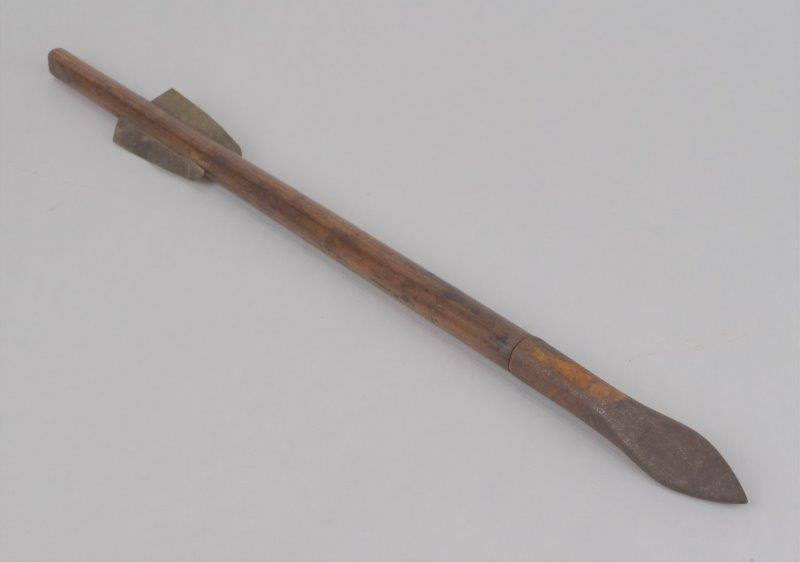 |
Crossbow bolt 17th c. Wood shaft with leaf shaped point with socket. Shaft fitted to the inside of the socket so that the outside of the socket is flush with the shaft. Vanes replaced. Exhibited: Feb. 10 2023-Oct. 2023 Orange County Historical Museum Hillsborough NC [inv. num. SW-17]
One crossbow bolt and several different styles of heads for arrows and crossbow bolts. |
|
| |
 |
Arrow and bolt heads 14-16th c. A set of arrow and bolt heads chosen to illustrate different styles of head and fit in a small space. Exhibited: Feb. 10 2023-Oct. 2023 Orange County Historical Museum Hillsborough NC [inv. num. SW-18]
|
|
| |
 |
Reproduction Armour circa 1400 Reproduction armour. Torso armour of plates covered in leather and attached by brass rivets. Made by Wade Allen, Aaron Toman and Charles Davis working as Valerius Armouries. Exhibited: Feb. 10 2023-Oct. 2023 Orange County Historical Museum Hillsborough NC [inv. num. R-14]
This is a piece that Wade made while working with Aaron Toman as Valerious Armouries in the mid 1980's. It wasn't bad for the time. |
|
| |
 |
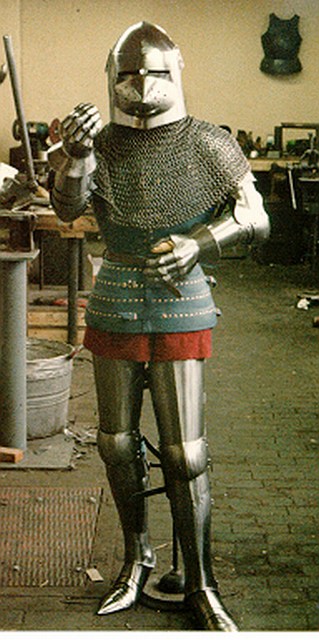
Child's Halloween Costume circa 1400 Armour made as a halloween costume for a 5 year old. Composed of a bascinet with an aventail attached with tubular vervelles. Breastplate of simple globose form, rolls at the neck and arms. Spaulders, arms, Cuises with articulated poleyns, frontal greaves and sollerets of short pointed form. All on a wooden base. The armour was worn by Geoffrey for Halloween 2005. Tracy made a new grand assiette gambeson based on the Charles de Blois garment. The legharness is suspended from points on the arming doublet worn beneath the gambeson. The arms and spaulders are secured by points to the gambeson. Armour by Wade Allen, clothing by Tracy Justus. The armour was worn several times. When it was originally made it consisted of the bascinet (without aventail), breastplate, spaulders, arms and cuisses. These were designed to be constructed quickly, not to be strictly authentic in form. It was made over a 4 day period based on shrunk patterns from the days working as Valerious Armouries, two of which were just evenings after work. The vervelles, greaves and sabatons were made later to complete the look. Exhibited: Feb. 10 2023-Oct. 2023 Orange County Historical Museum Hillsborough NC [inv. num. R-16]
This is an armor made as a Halloween costume for a friend's son. It was very simplified for ease of manufacture - I had 4 days to get it built. |
|
|