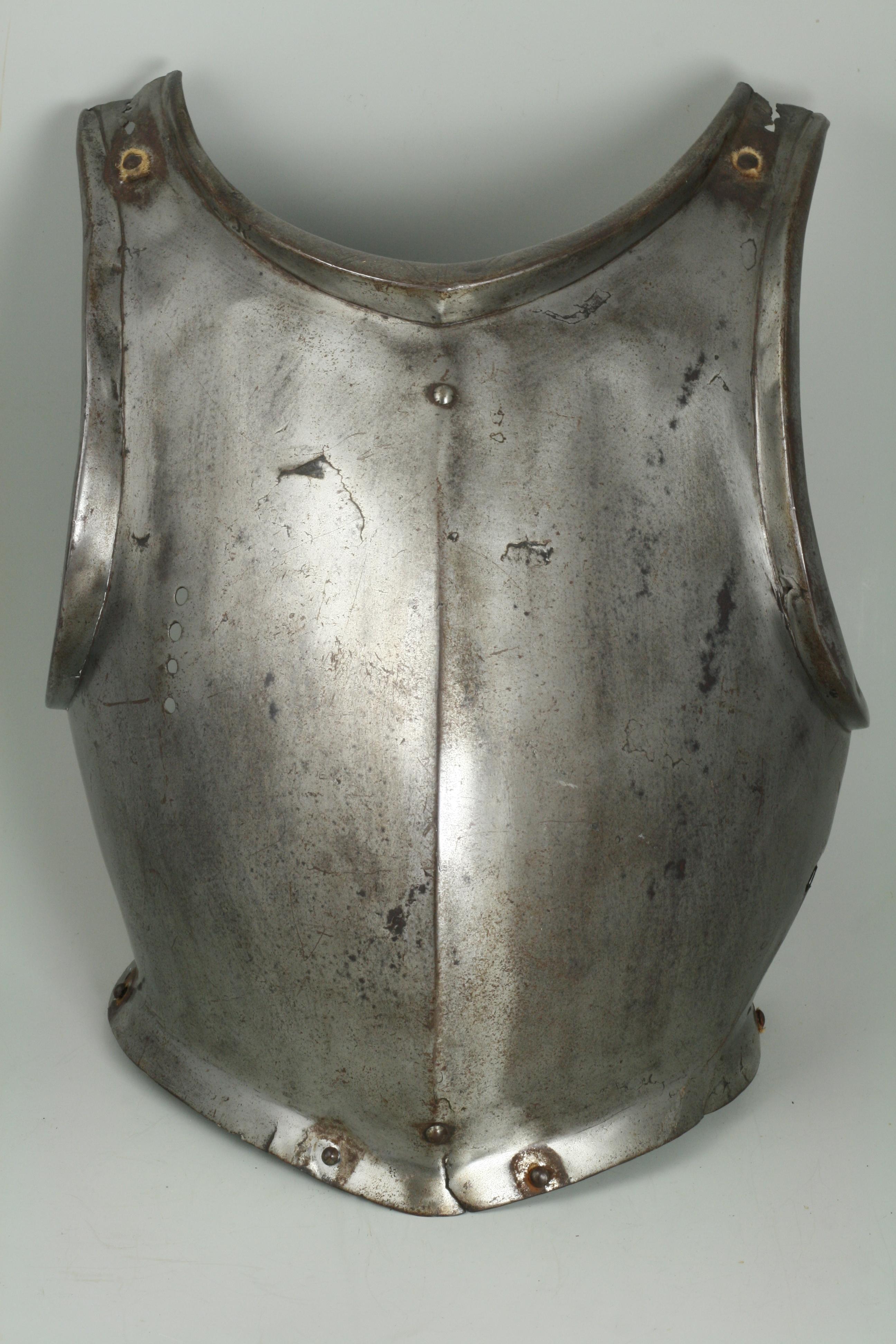


Italian or Flemish Breastplate circa 1500
Formed of a single piece with a medial crease, flared bottom edge and large triangular rolls at the arms and neck. The roll at the arm with engraved/filed decoration in the form of lines. There are a set of holes on the right side for the attachment of the pins for a lance rest. This is a fine example of a rare type of breastplate made at the turn of the 16th century. Examples like it may be found in the Waffensammlung Vienna, Metropolitan Museum NY, another in the current collection - item number A-321, etc. For a very similar example see Kienbusch Collection in the Philadelphia Museum of Art #1977-167-132 formerly in the Dean collection.
Size measurements: Width of neck hole - 8 1/2 in. Height of arm hole - 9 in. Arm hole to waist- 4 1/2 in. Center from top of roll to waist - 12 3/4 in. Waist flare - 3/4 in.
The metal varies in thickness. Within an inch it can vary about .01 inch. All measurements in inches. Thickness measurements:Sides - .028-.052 - mostly in the .030-.040 range. Upper area between arm and neck (right side) - .035-.050.Mostly around .040. Same thing (left side) - .059 - .075 (thicker than the other side). At the lance rest holes - .040 - .052. At the top crease area - .070 - .080 (mostly .080). At the center near crease - .080 - .11. Center near the waist - mostly .040 - .050. Height of upper roll at the center (measured with a gauge from the back of the material)- .66. Max height of right arm roll - .84. Max height of left arm roll - .71. Measuring from the front of the breastplate the rolls height and width at the widest spot are: right 3/4x13/16 inch, left 11/16x3/4 inch, neck 11/16x23/32. To generalize, the armourer was aiming for a roll about 3/4" high and about the same in depth (19mm). [inv. num. A-66]
Arm circa 1430
Extremely rare example of a 15th c. piece of armour. Arm for the left arm. Perhaps from the fortress at Chalcis (Negroponte). Formed of a tubular upper cannon that wraps two thirds of the way around the arm connected to a bluntly-pointed cop with an abbreviated wing by one lame. The cop is then connected to a tulip-shaped vambrace formed of two pieces hinged on the outside by hinges and secured by a strap and buckle on the inside. The cop is connected to the vambrace by two lames. The second lame is attached to the vambrace by means of 3 lateral slots allowing the arm to rotate. The lower edge of the vambrace is bordered by a line of small rivets. The lower cannon is marked by an indistinct maker's mark involving a split cross. The upper edge of the upper plate with a narrow, outward-turned roll and a line of rivets securing a (later) leather used to lace the armour to the arming doublet. The inner plate of the vambrace, one lame, lisiere d'arret, one half of one hinge, and all of the rivets replaced. The character of these restorations is similar to the restorations on the Rhodes pieces in the Royal Armouries. Given Claude Blair's association with the Royal Armouries and the presence of the letters HRR on the inside of the inner vambrace plate it is likely that this piece was restored there (HRR almost certainly represents H. Russell Robinson). From the personal collection of Claude Blair. For similar examples see Stephen V. Granscay, The Bashford Dean Collection of Arms and Armour...., 1933, nos. 76-81, pl. V. The most detailed record of the pieces discovered at Chalcis see C. J Ffoulkes, An Italian Armour from Chalcis in the Ethnological Museum at Athens, Archaeologia, LXII (1911) pp. 381-390.
Measurements 39 cm long. The arm is 15 in. long overall when straight, upper cannon 5 1/2 in. tall at the center of the cop, 4 5/16 in. wide at the top, 4 3/16 in. wide at the bottom. The upper cannon is 8 1/8 in. around the circumference. The roll at the top of the upper cannon is 1/8 in. tall and 3/16 in. deep. Lower cannon 7 1/4 in. long at the center of the cop, 3 7/8 in. wide at the elbow, 2 5/8 in. wide at the wrist. The cop 3 1/4 in. tall at the center, 2 in. tall at the wing, 1 1/2 in. tall at the back. The slots in the vambrace for rotation are 5/8 in. wide. The hinges are 3/4 in. wide, the upper one is 1 3/8 in. long. The inside measurements of the buckle are 3/4 in. on the wide side of the trapezoid, 5/8 in. on the short side and 5/16 in. tall. The thickness varies significantly. The upper cannon is .040-.090 in., mostly .050-.070 in. The thickest part in the center. The cop is .050-060 on the back and .070-.080 on the front. The outer plate of the lower cannon is generally .070-.080 in the upper center and .050-.060 near the wrist. The upper lame is app. .030 in. and the lower one .040 in.
Weight 2 pounds 7.2 ounces (1,110 g). [inv. num. A-186]
Cuisse for the left leg circa 1510
Spanish (possibly Flemish or Italian). Formed of a short cuisse plate, a long demi-greave, a central cop and two lames above and below the cop. All formed with a central crease. The cuisse plate slightly boxed and the outside and dished to conform to the thigh. The upper edge of the cuisse bordered by a recessed band and hollow roll. The cop with a raised central ridge and another bridging the transition from the cop to the wing. The wing with a recessed border. The demi-greave cut away on the inside of the bottom and bordered by a recessed band and roll similar to the top of the cuisse. The outside cut off straight. A single buckle remains on the outside of the demi-greave. There are rivets for securing straps and buckles on the cuisse and knee cop. Sold from the Parsons collection as late 15th c. but the character of the piece - forms of the rolls and boxing much more closely approximates 1510 - similar in many ways to the cuisses on Henry VIII's Silvered and Engraved armour. It appears that this was likely originally rough from the hammer and would likely have been blackened. This is very similar in form to the knees illustrated in Albert F Calvert - Spanish Arms and Armour - plates 17(b) and 99. They are described as late 15th c. Other similar items can be seen in Mann - Notes on the Armour Worn in Spain - Archaeologia LXXXIII for 1933 p. 300 fig. 7 and item #183 in the Kretzschmar von Kienbusch Collection of Armor and Arms 1963 - again identified as late 15th century Spanish. There are also two similar pairs in the Harding Collection in Chicago. One of these has been adapted to appear to have a more 15th c. style. One pair and one left very similar pairs are illustrated in armamento Medieval No Espaco Portugues items 21 and 22. These come from Lisboa Museu Militar Inv. MML numbers 21/37 and 21/69. 21/69 is nearly identical to this item..
Provenance: Dr. Peter Parsons Collection (2011), Brian Powers (1980)
Measurements - 15 in. overall height - others on the image. Thickness - cuisse .060-.070 in. cop .050-.060 in. demi-greave .040-.050 in. [inv. num. A-200]