
Waistcoat Cuirass. circa 1570
Italian. Formed to mimic the peascod style of civilian clothing popular at the time with a waist that droops at the center of the waist. Arms and neck bordered by inward-turned roped rolls. Waist flaired and cut to form picadills. Formed of five main pieces. The main front and back plates solidly at the side and shoulder. These units are then secured to the central back plate by two hinges and an alignment pin on each side. The front is decorated with a line of pointed buttons and secured by a hook through a hole in a peg at the base, a turning hook in the center and a pin in the gorget plates. The neck is extended to form an integral gorget. The gorget, like the cuirass, is formed of 3 separate pieces. One that extends the central back plate, the others that cover the sides and join at the front. The Italianate details include the form of the peascod (more rounded) the overlap at the center (many German ones just overlap to the center), the buttons down the center, and the relatively straight form of the gorget plates. All of the turns have wire inside.
The waistcoat cuirass was based on several surviving Italian waistcoat cuirasses. These included examples in the Wallace collection, Chicago Art Institute, etc. Primary design was taken from one that survives in the Odescalchi collection in Rome in the Museo di Palazzo Venezia #1251. It is illustrated in figures 167 and 168 in Armi e Armature Lombarde. Since this was made we have added item number A-240, an example of a similar type of cuirass.
Tracy was allowed to design the clothing to suit Italian styles of the appropriate period. The outfit was inspired by a 1560 portrait by Giovanni Moroni, "The Man in Pink". It is made of silk and linen. Additional sources include a couple of outfits described by Janet Arnold in Patterns of Fashion 3 to pattern it: the 1562 grave clothes of Don Garzia de Medici and the 1618 suit of Sir Richard Cotton. There are a couple of deviations from period practice for the comfort of the wearer - the doublet and breeches do not lace together and there's a zipper behind the codpiece. The overall look is good. Geoffrey is tall and slim so he has the right physique to pull off this kind of thing. Embroidered silk-covered bead buttons.
Formed from 14g for the breast plates, 16g for the back plates and 20g for the neck plates. Full-wrap hinges formed of 20g. All of 1050.
Armour by Wade Allen, clothing by Tracy Justus. Produced for Geoffrey Allen when he was 12. [inv. num. R-35]
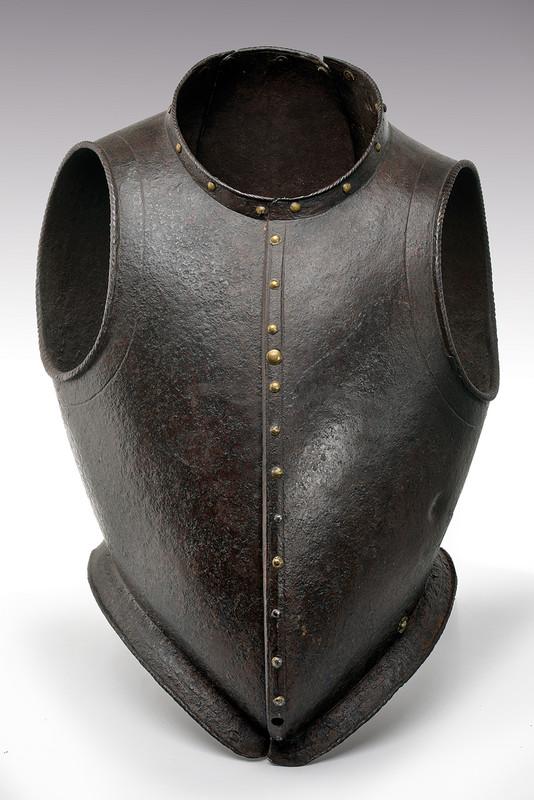
Waistcoat Cuirass circa 1580
Italian. Full peasscod shape mimicing the doublet of the time. Formed in three pieces, one narrow one down the center of the back and two sides which join at the center of the front. The sections are secured by a pair of interior inset hinges in the lower portion of the back. Arm holes with outward turned roped rolls bordered by an engraved line. Neck and waist edges with inward turned finely roped rolls and bordered by single incised lines. The front is decorated with a series of false buttons formed of iron rivets with brass caps, a few of which have lost their caps. The cuirass is secured closed by means of two threaded studs on the interior plate that engage holes on the outer plate. Currently one of these holes is filled with a modern brass bolt. The top edge is formed into a low straight collar, the bottom edge is flared out below the waist. Shot proof thickness with what appears to be a proof mark on the left side. A nice example of a rare type of body armour. Several defenses of this type (etched) survive in the Wallace collection. There are a few plain ones in the Graz arsenal. These are normally thought of as light civilian armours or decorative, but there are several like this one that are definitely designed for protection against weapons used in warfare.
Measurements: Width under the arms 14 in. width at the waist 10.25 in. height at the back from the waist to the top of the collar 16.25 in. Neck hole 6 in. wide and 6.25 front to back. Thickness varies significantly and apparently intentionally. Selected locations on the center back plate are app. .10 in. The shoulders vary between .16 in. and .18 in. Thick spots in the front are .30 in.
Weight: 26 pounds 11.2 ounces (12.114 kg).
Provenance: Peter Finer. Listed in the 1996 catalogue. Previously from the Christies sale Weds 22 July 1992 lot 105 where it is compared to the Cologne-made waistcoat cuirass in the Kienbusch Collection (no. 29) [inv. num. A-240]