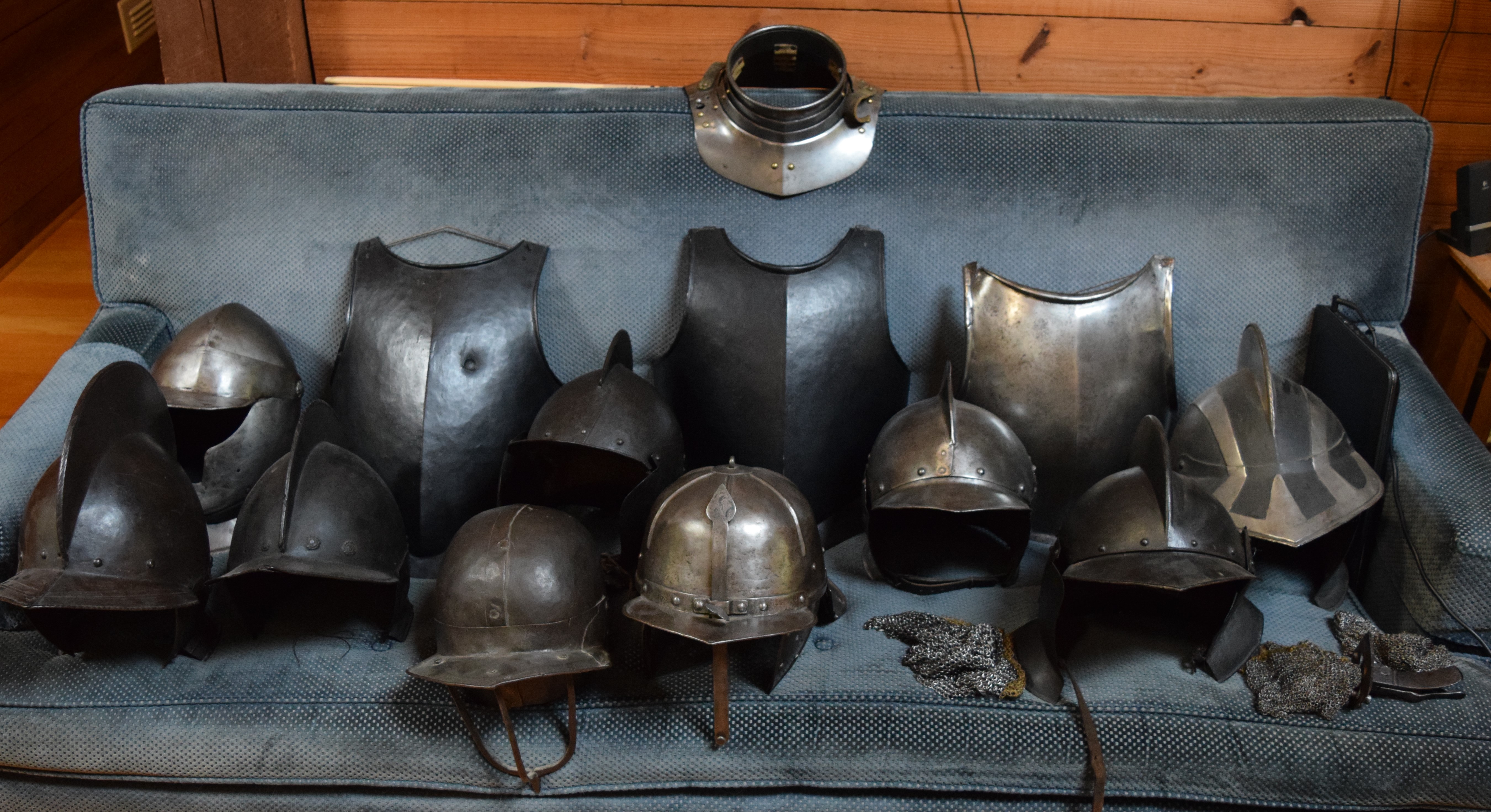
After our visit to Jamestown in May 2023, we arranged for people who work at Jamestown to stop by the collection for an in depth study of particular pieces. In this case, there was no initial list of items to be studied. The Jamestown people asked to see types of items, or details of construction and I pulled out appropriate pieces. This picture shows many of the items we ended up studying all laid out together.
We started with a set of two piece burgonets that would allow us to study and compare different ways this was done. Two piece helmets are common in the pieces found at Jamestown.
Then we pulled down a couple of late 16th c. breastplates which should be the kind that would have been sent across the pond. One is light (and has nicer shape), one is definitely not light. The differences in construction are well worth studying.
Then we pulled down a couple of lobster tailed pots. One is a typical continental one, the other very English. These were of interest because they are working on one for Jamestown at the moment.
Then Fred wanted to see an earlier breastplate.
Parker has been working on some mail, so we pulled some small pieces out. We compared the links on a piece he has made to these and to two shirts which were lightly inspected in situ.
Jamestown uses a lot of cabassets in their fort and they are planning some work on a new higher end piece. So we pulled the cabasset from the Pisan armor. It has etching, which is fun, but it also has a very elegant version of the typical shape. This was studied, photographed and measured.A few more random pieces were pulled down. I brought out my new lance rest for fun, A random discussion brought up rolls, so I illustrated the "jelly roll" on the top of a gorget and there are mentions of "short tassets" being preferable for use in Jamestown, so I pulled out a tasset that can be worn in long or short form.
Part of the study performed included taking copies of the form of several pieces using aluminum foil and masking tape. This allows a full 3D model of the outside of the piece to be pulled directly from the piece. The copy reflects the size of the piece and its shape. This allows for later off site study and to create patterns with a direct frame of reference.
After the study of original pieces, we spent a day of shop time. We worked on two pieces. One was a simple skull cap. This was used to illustrate working from (relatively) thick material to pull the volume of a piece through sinking. We started with an 8 1/2"x10" piece of 1/8" sheet (corners rounded), drew out the outer 1 1/4" using the power hammer and by hand (to demonstrate both methods). This made the blank about 1" larger in each direction. The intent was to eliminate the inevitable thick edge if you just sink a piece directly. It mimics the methods used in Bienno to prepare the blanks for buckets. After this we dished the piece out. The edge work and dishing were done hot using my "Eric Thing" forge. The final size of the helmet is 7 1/2" wide, 9" long and it was 4 5/8" deep (depth measurement from the table, edges arch up). We verified the thickness at stages of the work and at the end using the AcmeArmourCaliper. The result was a pretty credible skull cap in Fred's size. The resulting thickness was pretty variable, but generally .04-.06 (mostly in the .06 range) but with a top that is generally .08-.09. Not bad for a wild guess. Parker also started work on the new cabasset for the Jamestown Settlement. He chose to raise this in the traditional way starting from a 14" disk of .060 material. He completed 2 full passes and started the third.
Attendees: Wade Allen, Frederik Scholpp and Parker Brown.
 |
Burgonet early 17th c. Two piece bowl joined at the center over a short, high central comb by a roll. The remainder joined by a flat riveted seam. The brim formed from a separate piece riveted to the inside of the front of the skull. The back of the skull with a neck guard formed of a single plate. Cheek plates with a flare continuing the line of the neck guard. Main edges with with plain inward turns. With old and probably working life lining quilted canvas lining stitched to leather strips at the forehead and neck. Cheek plates with loops at the lower corners used to secure a lace. The right cheek plate stamped with the number 197. Original black finish which has been refreshed with paint. Right cheek plate appears to have been reattached. Cheek plates secured at the chin in a common way - with a loop at the lower corner of each through which a thong is tied. [inv. num. A-257]
|
|
| |
 |
Burgonet early 17th c. Two piece rounded skull joined at the center along the crest with a roll. Fitted at the front with a pivoted peak and at the rear with a single neck lame. Comb polished bright. Additional bright band at the middle of each side. Peak, cheek plate, and neck lame with polished borders and roped inward turned edge. Right cheek plate lost. Left cheek plate with polished front border and a raised circular area at the center polished bright and pierced with holes. Surface cleaned and black refreshed with paint. The pivoted brim moves very little. It appears that simulating pivoting has been done as an alternate way to secure a separate brim to a burgonet with a two piece skull (instead of riveting it inside as has been done on A-52, A-71 and A-234). [inv. num. A-258]
|
|
| |
 |
Burgonet circa 1600 South German. Two piece skull with high comb and integral peak and neck. A pair of small cheek plates. The two halves of the skull joined by a roll at the top of the comb and simple overlaps in the peak and neck. Rough from the hammer. Lining rivets at the face and neck lines. The lining rivets with embossed decorated brass washers. This is comparable in construction and style to A-105, but that was originally a much nicer piece. This is the munition version of that. A similar burgonet is illustrated in plate 52 in Musee De L'Armee Paris - Les Armes Et La Vie - Dargaud Editeur 1982. It is described as c. 1550, but that seems early. [inv. num. A-277]
|
|
| |
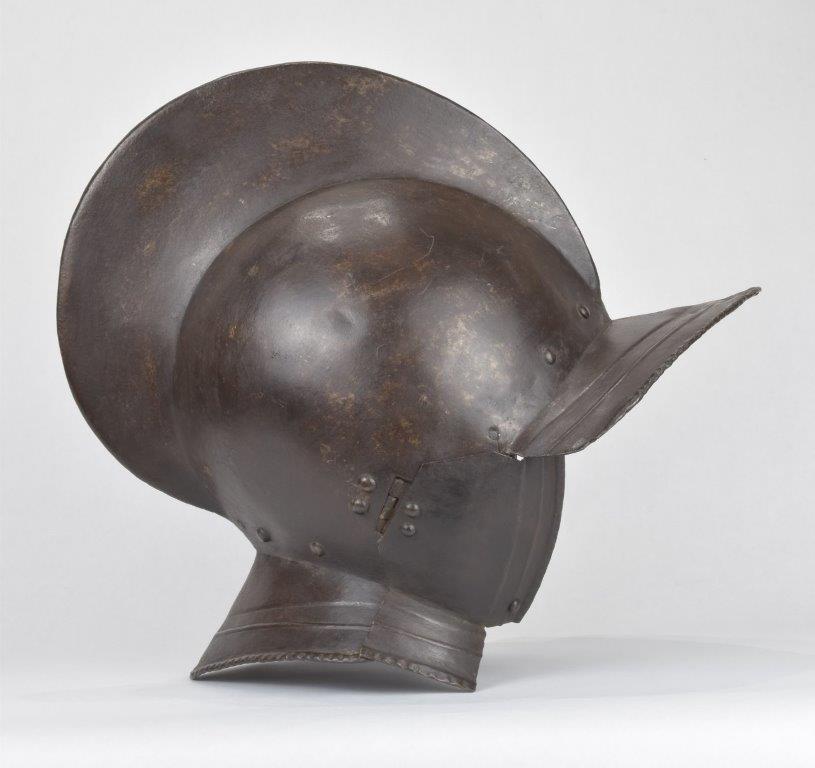 |
Burgonet circa 1580-90 Skull formed of two pieces joined down the center. High comb and pointed brim and nape. Edges of the brim, neck and cheekplates with small inward turned rolls at the edge which are heavily roped with broad dents. Inside the rolls there is a wide recessed border which contains a central raised ridge. The comb is lightly roped with diagonal filed lines. Dome headed lining rivets in the skull at the base of the brim and nape securing remains of lining leathers. The bowl is formed the way two piece morions are formed - the brim and tail are integral to the bowl and the seam runs out to the points at the crease. The inside of the brim and one cheek plate are marked with three parallel chisel marks. These seem to have been used to keep parts organized during construction. Measurements: weight: 3 pounds 11.6 ounces (1685g). thickness: skull generally .045 in. varying .025 to .055. Brim slightly thicker generally .053-055 in. left cheek .035, right cheek .025. [inv. num. A-322]
|
|
| |
 |
Burgonet circa 1600 South German Probably Augsburg. Two piece skull with high comb and separate inset peak and separate neck lame. A pair of cheek plates (the left probably associated and slightly worked to fit at the bottom). The hinge badly replaced on the re-worked cheek plate. The two piece construction is much nicer than many helmets. The two halves fit, are at the same level and the seam in the comb can be confused with an engraved line (which it was in the auction description where it was described as having a one piece bowl). Rough from the hammer. Edges with plain inward turns. Lining rivets at the face and neck lines. [inv. num. A-284]
|
|
| |
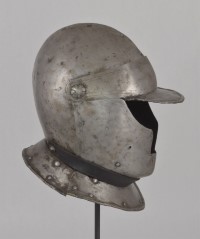 |
Italian closed burgonet circa 1620 Skull formed of 2 pieces, the right side overlapping the left. Seam forms a crease, not a raised comb. 2 halves are riveted together. Decorative filing at the crease to simulate roping and a pair of parallel lines on each side of the roping. Matching parallel lines on the edges of the peak, bevor and neck lames. Small movable peak of round form. Bevor extending up to cover the cheeks and form a 'Y' shaped hole. Peak and bevor pivoted on the same rivets. Single neck lames at the front and back with rolled lower edges. Rolls decorated with simple filed roping. Bevor secured by later strap and buckle. Overall very light weight like many of the munition morions and open burgonets. Cleaned on the outside, showing remains of modern silver paint on the inside of the neck lames. Measurements: Weight: 3 pounds 2.6 ounces (1435g). [inv. num. A-59]
|
|
| |
 |
Burgonet early 17th cent. German, probably Nuremberg. Rounded skull with tall comb formed of two pieces. The pieces are joined by a flat fold at the top of the comb and flat overlaps in the front and back. Separate brim riveted inside the skull. Separate tail lame attached to the outside of a flare at the back of the skull. Borders of the tail and brim with simple inward turns, the one on the tail rolled around wire. Cheekplates with flared bottom edge following the line of the neck lame. Bottom and front edges with simple inward turns. Cheekplates secured to the skull with internal hinges. This is an interesting example of a relatively degenerate burgonet. Formed of two pieces to simplify construction, separate brim also minimizes metal work and the shape covers somewhat less of the forhead than normal. Even at this level it appears to have been originally ground to a white surface. [inv. num. A-234]
|
|
| |
 |
Shot proof Breastplate circa 1600 Simple one piece breastplate with central crease which droops to form a peascod at the waist. Arm and neck holes with simple outward-turned, lightly roped rolls. Flaired at the waist. Pierced with holes for shoulder straps at the shoulders and with pairs of holes for three straps on each side to secure tassets. Rough from the hammer finish. Proofed with a musket in the chest. Marked with an unidentified mark resembling '8Z'. Minor delaminations on the outside and some major delamination in the inside near the center of the neck. Measurements: Weight: 16 pounds 9.2 ounces. (7,520 g). Thickness at the center of the bottom half up to 0.340 in. but generally closer to 0.290-0.320, in the top it reaches 0.350 inches near the center, tapering down to 0.250 in. at the shoulder, and down to 0.130 in. at the sides. [inv. num. A-209]
|
|
| |
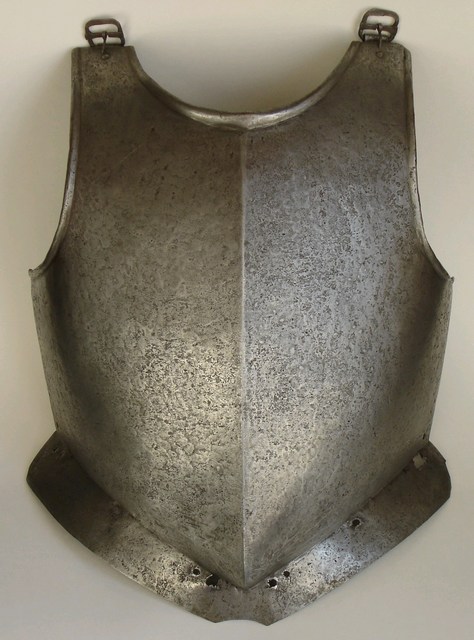 |
German/Austrian (possibly Gratz) Breastplate circa 1590 Including 2 buckles at shoulders. Rolled edges at arm holes and neck, full flare at waist - used without any fauld lames. Simple peascod shape. This breastplate is relatively light and most likely sword proof and not shot proof. This item is very similar to large numbers of breastplates in the Arsenal in Graz. Its original blackened finish has been removed by cleaning with acid. Originally it would have been used with a pair of tassets suspended directly from the wide flare at the waist of the breastplate - taking the place of the fauld. The holes for the tasset straps are evident. Each tasset would have been suspended by 3 straps and buckles - the ones nearest the edge and center of the breastplate were attached by 2 rivets, the central one with a single rivet. Weight 3.5 lbs. rough inner and outer surfaces, but roughly .050-.060 inch thick overall. [inv. num. A-15]
|
|
| |
 |
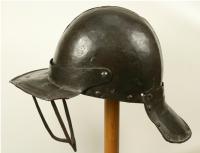
Lobster Tailed Pot circa 1640 "A lobster tailed pot. Helmet bowl formed in one piece with raised lines radiating from the center. Articulated tail formed of 4 plates each with rolled outer edges. Secured at the sides by articulating rivets and with the remains of a central leather. 2 cheekplaces with rolled edges and central perforation. Brim fixed to the bowl. Sliding nasal secured by a turn-screw with large flattened head. The center of the bowl has a loop secured through a round washer. Leather strips for securing the lining remain around the tail, cheek plates and bowl. The helmet is marked with an M at the point of the brim on the outside and a broad V on the inside of the brim. The marks on the helmet resemble the marks used by the London Armourer's company, but the one piece form is more typical of the continent and is possibly of German manufacture. [inv. num. A-65a]
|
|
| |
 |
Lobster-tailed pot circa 1650 Deep, heavy bowl formed of 2 pieces joined at the center with a flat riveted seam. The seam is inset to that the outside is flush. There is an engraved/chiseled line on the other side of the seam to simulate a central band. The bowl is rough-from-the-hammer. Pointed, hinged fall with 3 bars covering the face. Tail of one piece simulating 3 lames. The outer border of the tail has an inward-turned roll and a parallel recessed border. Lining rivets around the front edge of the bowl and along the edge of the tail. Skull marked on one side near the bottom. This mark appears to be a crowned IR, relatively illegible. This appears to be normal - see The London Armourers of the 17th Century by Thom Richardson, page 19. Cheek plates missing. The 2 piece skull and 3 bar face are typical of English armour of the period. Measurements: bowl 8 3/4 in. front to back, 6 3/4 in. side to side, 6 in. deep at the center, bars 6 1/2 in. from the base of the brim to the bottom of the point. Thickness: Tail .040-.050 in., Brim mainly .040-.050 in. except at the corner and pivot area where it gets much thicker - app. .090 in. The bowl varies significantly in thickness. It is generally thinner at the bottom and thicker at the top. A sampling of measurements show .070, .150, .090. It is generally around .090-.120 but it varies significantly in a small area. [inv. num. A-183]
|
|
| |
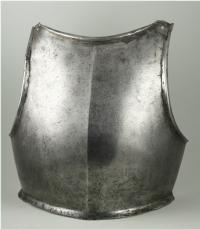 |
Breastplate circa 1500-1510 Italian/Flemish. One piece breastplate with central crease. Angular outward-turned rolls at the neck and arms. Flaired bottom edge for a fauld. Measurements: 13 in. tall, 13 1/2 in wide below the arm holes, 11 3/8 in. wide at the waist. Thickness: center mostly .120-.140 with thick spots up to .150, side tapers down to .080, shoulders taper to .050, but only right at the edge more of the shoulder area is no thinner than .080. Rolls up to app. 1/2 in. tall at the center. Weight 5 pounds 11.6 ounces (2.595 kilo). [inv. num. A-239]
|
|
| |
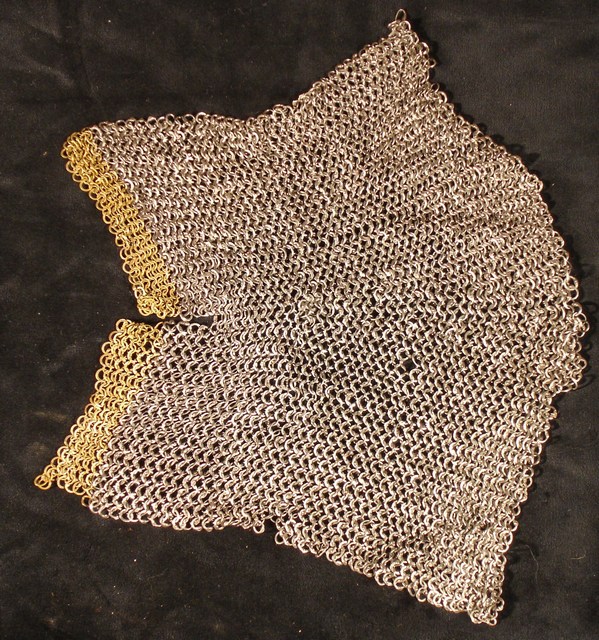 |
Mail Voider 16th century For the right arm. Rings of somewhat flattened form. Rings averaging app. 7 mm outside diameter. Overlap in the form described as pent roof on both sides. Wedge rivets. Tapered with expansion under the arm to accommodate the shoulder. Wider across the back. labeled as German. The pent roof shape of the overlap is associated with German manufacture. Small brass borders of alternating solid and riveted rings eleven rows wide (6 solid, 5 riveted.). The solid rings flat, the riveted rings of round section. Wedge rivets. Border is secured by a line of flattened butted rings indicating that it was almost certainly added after the working life of the piece. App. 9 in. wide at the cuff, 9 in. long at the edges, 10 in. long at the center and 15 in. wide at the base. Detail images over the scale show the outside and inside of the rings. Microscope images show: first and second show a broken ring where the rivet has held, though the top of the overlap has partially torn free, third shows striations (possibly from punching) on the solid latten rings of the edging, fourth shows draw marks on the riveted latten rings and burring on the punched rings, fifth shows the back of the brass wedge rivets and more striations on the punched rings, sixth shows the shape of a rivet hole in the latten rings - a trapezoid similar to a sharp-cornered USB connector. Detailed images and analysis by Mart Shearer. [inv. num. M-4]
|
|
| |
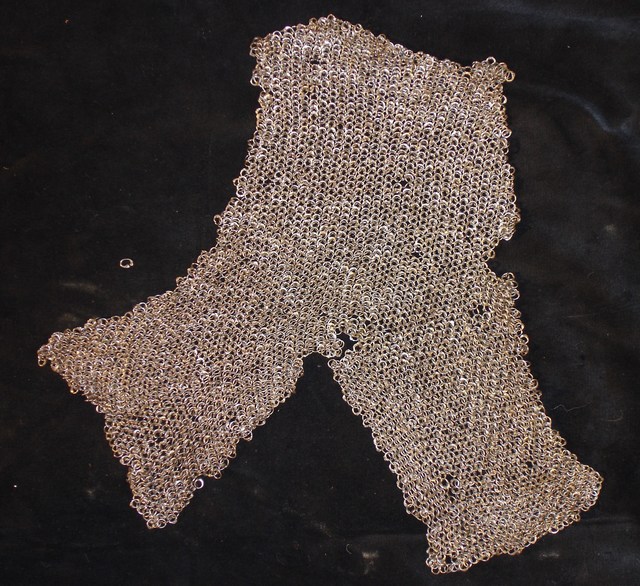 |
Piece of Mail 16th century Piece of Mail. Rings of round cross section except at the overlap. All rings rivetted. Wedge rivets. Detailed analysis by Mart Shearer shows that this is either the remnant of, or perhaps a piece in progress of becoming an armpit defense, commonly called a voider. Ring level detail images use a millimeter scale. They show (in order a-h):
|
|
| |
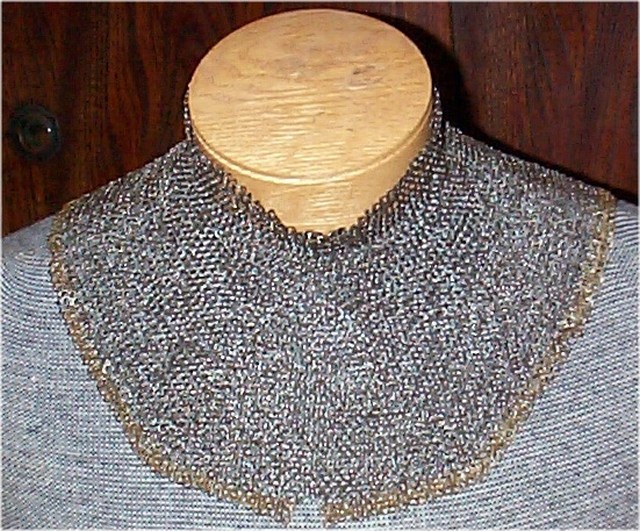 |
European Mail collar 16th century Mail Collar. Formed of very small rings (app. 1/8 inch i.d.) of round cross section. Taper formed by the addition of a triangular gusset in the middle. 6 1/2 inches tall. Body of rivetted rings. Wedge rivets. Border of 3 rows of brass rings - 2 of solid punched rings and one riveted. Formerly in the collection of Leonard Heinrich - armourer to the Metropolitan Museum of Art, NY. [inv. num. M-5]
|
|
| |
 |
South-German Tassets mid 16th century For a half armour. Seven lames, the upper four detachable. Creased center line. Hammered floral decoration on the terminal lame and leaf form decoration on the top lame. The bottom edge of the bottom lame of each segment with full rolls with fine roped decoration. the rolls on the terminal lame tapered and with a central bump. Lateral double decorative lines running up the sides. Decorative file work at the centers of the tops of the lames. Very nice, full form. Old leathers (one detatched from one plate). Old rivets and matching buckles (some tongues defective). The upper and lower sections secured by a keyhole slot and peg at the outside and a much smaller keyhole slot engaging a turning pin at the inside. Decoration on the terminal lame similar to the decoration on the terminal lame of the tassets on item number 23 in the exhibition of Brunswick armor at the Tower of London April 10-October 31 1952. Those tassets have more lames and no decoration on the top plate. Overall form, terminal plate form and rolls and buckles also similar. Exhibited: Feb. 10 2023-Oct. 2023 Orange County Historical Museum Hillsborough NC [inv. num. A-62]
|
|
| |
 |
Gorget circa 1560 South German, probably Augsburg. Of bright steel composed of 4 plates front and back. The top one with inwardly-turned and roped roll, the bottom one drawn down to a blunt point in the front. Hinged on the left side with an integral hinge in the top collar plate and a rivet in the main plates. Secured by a rivet on the rear plate engaging a keyhole in the front plate and two pins engaging holes in the upper plate on the right. Two pins are relatively rare. This may be to keep the upper plates aligned perfectly if the collar is meant to engage a roll on the bottom of the helmet. The upper one is secured to the rear plate and engages a hole in the front plate, the lower one is secured to the front plate and engages a hole in the rear plate. The top corners of the second rear plate are notched to allow the gorget to open, the plates to fit nicely and still allow for an overlap. With brass-capped rivets throughout. The rivets that secure the straps for the pauldrons are modern. The other rivets may be original, which would make the leathers original. Possibly some form of mark on the main front plate. Very nice form with tapering neck plates. The gorget includes two straps for securing the pauldrons which appear to be later replacements. Details of the contruction including the difference in thickness between the front and back plates, the double pins, beveled edges, inset hinge, brass capped rivet heads and finished edges of the inner plates indicate this likely formed part of a high quality armour. This is very similar to the gorget on Wallace A45 catalogued as A45.02 and WAM 2014.1175.2 formerly in the John Woodman Higgins Armory Collection. The leathers are old and collapsed so the images do not show the plates sitting as they should. The gorget should be much taller. Ex. Coll. Peter Parsons (2011), Robin Wigington (1977), Part of a South German armour sold by Sotheby , Co. London 12 Feb. 1974, lot 172. 10 3/4 in wide at the back, 8 3/4 in wide at the front. Thickness varies on the front main plate between 0.070 in. and 0.095 in. It is generally in the 0.080 in. range. The main rear plate is thinner - 0.040 in. to 0.055 in, mostly .040-050. Weight: 2 pounds 8 ounces (1,130 g) [inv. num. A-201]
|
|
| |
 |
Lance Rest circa 1560-80 Likely Italian. Good example of a hinged and spring loaded lance rest from the second half of the 16th c. Similar ones can be found on armors made in Italy and Germany, but the form of this one indicates that it is most likely Italian. The base plate is secured to the breast plate by two bolts. The rest is secured to the base plate by a tenoned plate. The rest hinges up. The rest includes a spring loaded lever that holds the rest in the down and up position. Includes 2 bolts and a plate that acts like a nut inside the breastplate. Compare in form to the much higher quality lance rest on A0060 and A0055 in the Wallace Collection. [inv. num. A-349]
|
|
| |
 |
Rapier 17th century Rapier. Swept hilt. Long blade of diamond section. Tapered pommel. Wire wrap replaced. [inv. num. W-27]
|
|
| |
 |
Rapier 17th century Long diamond shaped blade with narrow fuller toward the hilt. Flat ricasso within the hilt. Hilt formed of tapered bars of rounded form. Oringinal wire grip with turk's head knots at each end. Pommel lightly faceted. [inv. num. W-53]
|
|
|