


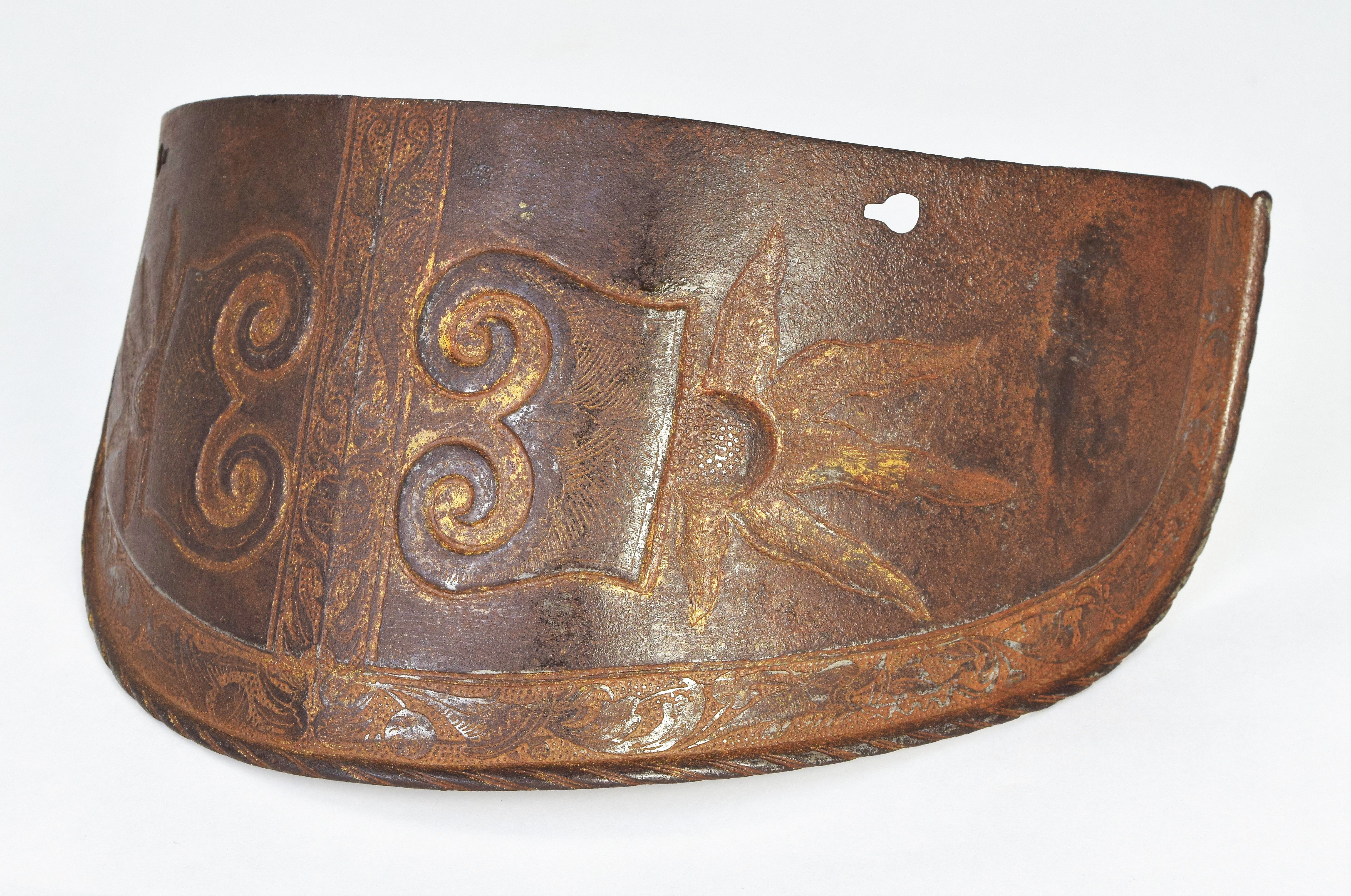
This paper documents the process to accurately assess and catalogue an individual element of European armour. This often starts from nothing. No provenance, no guarantee, and (often) not even a date. The piece must be evaluated based on its form, construction and decoration. Evaluation includes physical examination, searching for comparable pieces and, when the piece is decorated, analyzing the decoration to understand what it tells us.
This piece was purchased in person from a dealer following the all too normal pattern of exchanging money for the piece with no written information provided. The seller verbally indicated that the piece came from Madrid, or possibly Lisbon with no supporting documentation. The seller also failed to provide any statement or guarantee as to the likely origin or date of the piece. Functionally this piece has no provenance.
So, as is often the case, I had to start from scratch in assessing and describing this piece. The initial assessment had to be made before I purchased the piece. I had to be comfortable that the piece is something that interests me, in my case that means that it has to be antique and have some construction detail that will add to the the scope of my collection. This has to be done on the fly. At an antique show this often has to happen before you put the piece down. Once it lands back on the table, someone else may pick it up and buy it. In this case, the piece "looked good" and I thought that the decoration could provide an interesting study. The price was low enough that it seemed worth buying. Once I got it home, I could write up a basic description, photograph the piece and publish it as part of the collection.
Several aspects of the piece allowed me to start to identify it:
Single plate. Inward turned roll around the bottom edge extending up the sides. For the left leg. Two keyhole slots at the top for attachment to the upper tasset plates. Embossed and recessed decoration with etching. Recessed border around the edge with etching. Central band of etching. Purportedly from the Madrid Real Armeria after the Spanish Civil War (according to the seller), also attributed possibly to the Lisbon armoury. The decoration on each side is a fire steel and stone creating fire. This symbol is associated with the Order of the Golden Fleece.


The first somewhat comparable fire steel decoration I found in museum visits was during a trip to Vienna. A slightly different form of the same image appears on the elbow wings of an armour for Philipp II of Spain that was made in 1544 by Desiderius Helmschmid (A 547 in the KHM). The steel itself is similar, but the "stone" is very different and the flames are very different in style. Also, the background around the fire steel is etched.
There are a number of other armours that are decorated with various forms of the fire steel motif. The following is a sampling of the examples I have found.




I found several armours and horse armours decorated with fire steels in the Real Armeria in Madrid. Where the fire steel is a central element of the decoration, the style is generally more similar to that of this tasset plate. The etched decoration on the embossed areas on the larger pieces is generally more detailed here, but these pieces allow for larger areas of decoration. The saddle steels in particular have large surfaces, so they allow for a much larger decorative element, and so a lot more detail.


The decoration on what remains of one armour stands out. Surviving elements of an armour for Charles V attributed to Kolman Helmschmid, Augsburg 1531 (A108) are decorated with nearly identical fire steels embossed in the same fashion and decorated with matching etching. The pictures of the elbow and knee show that even on a single armor the craftsman would adapt the specific form of the decoration to fit within the space available on that element. The number, size and spacing of the flames specifically varies the most. When we look at the other aspects of the decoration we see that the form of the fire steel, the line decoration around it, the etching pattern on the fire steel, the form of the "stone", the overall style of the flames and the etching in the flames are the same as the corresponding decorative elements on the subject tasset plate. Comparing the other decoration on the plate, I worked my way up the central band of the tasset on a raw image and found a section of the etching that seems to match including the pomegranate and similar leafy decoration. Another raw image also shows that the tassets are designed to be separated at two places. The knee and three lames above can be removed to create long tassets without knees and the tasset can be worn as short tassets (separating between the 4th and 5th lames). The size of this plate would probably work best as an addition to the "short" form of the tassets. The rolls on the edges of the subject plate and the knee also match - having a narrow inward turned roll with double line roping. Interestingly, the roping on the edge of the elbow displayed as part of the same "suit" does not match - it doesn't have the same second line in its roping. The etching in the border does not appear to match what I see on the existing tassets. Despite this, the current plate could be part of the same garniture as many of the armours for Charles V are large enough and have enough spare parts that their etching does not match. For example, the Muhlberg garniture appears to have app. 20 different border etching patterns represented.
Additional pictures of the tassets that form part of A108 would allow us to confirm that the holes in the subject plate might line up with the existing pegs. Once that is confirmed, I expect that further confirmation would require detailed measurements of the subject plate to measurements of the 5th lame of the tassets. If those seem to match, then it would be very interesting to attempt to fit this plate to the left tasset of A108.
I do not know that there is a matching plate in Madrid, and from what we have seen so far there is no way to know whether this armour might have originally included separate tasset end plates.


During a discussion of this piece with Chassica Kirchhoff (June 2025) she shared the interesting included image on the left (C. Kirchhoff, 2017) from the Inventario Illuminado which illustrates an armor decorated with fire steels which also includes a pair of single plate tasset terminal plates as exchange pieces. She also said that in his KHM facisimile of the Inventario Illuminado (image on the right of the copy of the facsimile in the Heidelberg University library), Valencia alluded to its identification as Real Armeria A108, described in the Relacion notarial de Valladolid as "Arnes negro, de Colman con estas piezas y dorado," and further described in Valencia's "Catalogo Historico-Descriptivo De La Real Armeria De Madrid" on p. 38-39 (the suit is not illustrated). This was one of the armors that Kolman began in 1531, and that was delivered in 1532 (as Kolman died that year, this makes it one of his last armors for the emperor, perhaps based on measurements acquired during his trip to Toledo in 1529).
A108 is also described (and also not illustrated) in the following:
The text found on page 90-92 describing A108 (and A109) is:
A108 is a light harness for war, made by Colman Helmschmied. The emblem of the Golden Fleece predominates in the scheme of its decoration.
Of this suit the Conde de Valencia says:
Time has dimmed the effect of its sober and severe ornamentation of gold on a black ground, confined to a few narrow longitudinal stripes engraved and gilded. It has the ‘bars’ of the Golden Fleece on the helmet, the guards, and the shield; two winged griffins, supporting the Pillars of Hercules on the backplates of the pauldrons, and the image of Our Lady on the breastplate. According to the Emperor's inventory, the backplate, which does not exist, bore the image of St. Barbara.
It is the last armour the famous Colman made for Charles V. This is easily proved by the date (1531), engraved on the left tasset, a date which agrees with that given us some years ago by the learned German professor, Carl Justi, to whom it was communicated by Canon Braghirolli on his finding it in the Mantua archives. It is contained in a letter from Duke Federigo di Gonzaga to the Duke of Urbino on the 9th November, 1532, in which he says that the Emperor had shown him his armour, among which was a beautiful suit by Colman, the last one he made for him, for shortly after he had died. The statement was confirmed by the payment lists of the Municipality of Augsburg, from which the name of the armourer disappeared in the year 1532.
The helmet is a celada de infante, and has a visor with wide gratings fastening over the beavor. The evolution of leg-armour is well shown by the tassets extending, in several plates, below the knee where they overlap the demi-jambs. There are no genouilleres. The lower plates of the tassets were detachable, those pieces being thus convertible into tassets of ordinary length. The shield (A109), embossed with the devices of Burgundy and the Golden Fleece, was found in the province of Burgos, where it was bought for seven pesetas. It was purchased for the nation by Alfonso XII. at a cost of 1,250 pesetas.
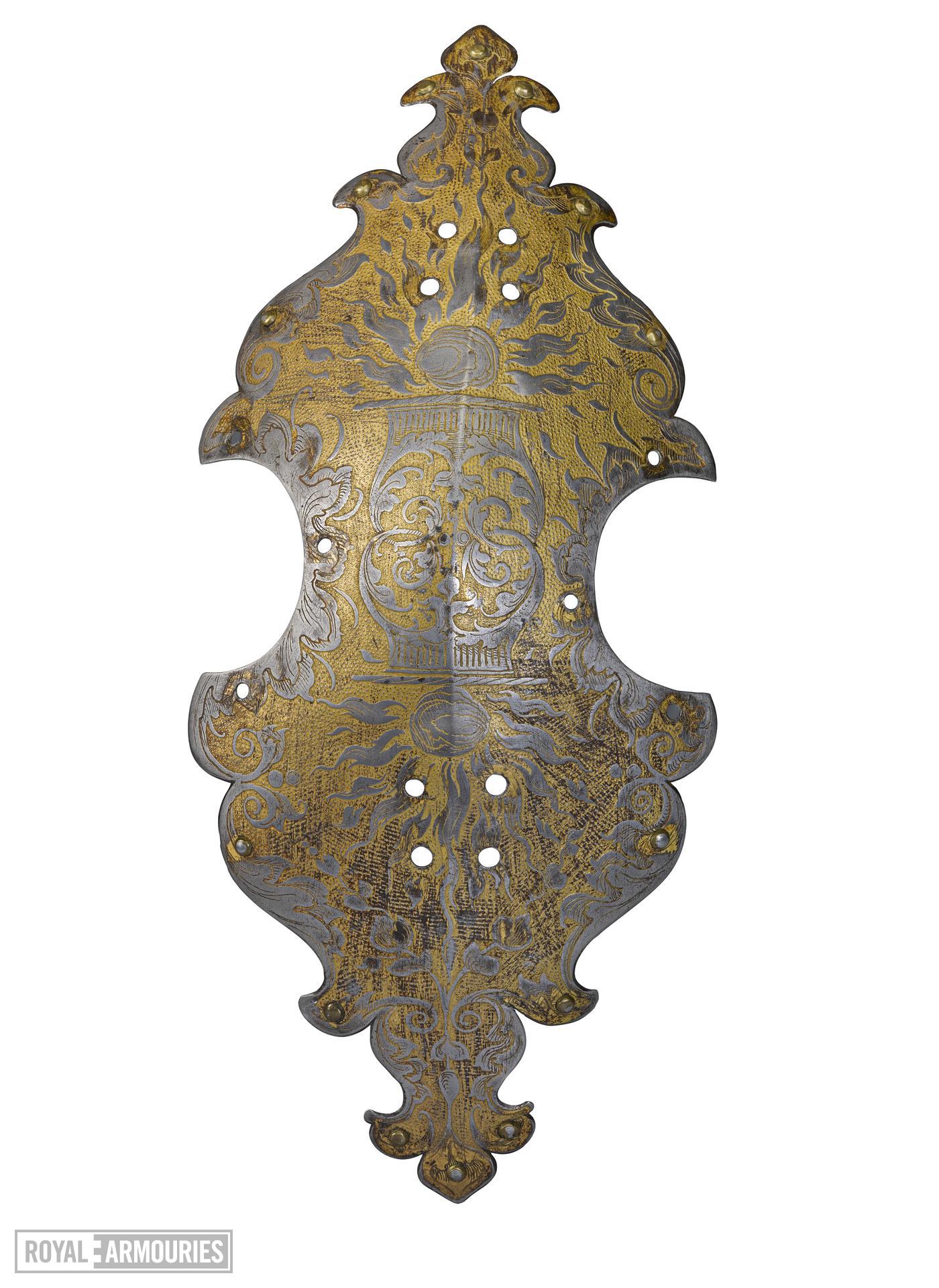
If there is any chance for this piece to be part of A108, then pieces must have found their way out of the Real Armeria in Madrid after the Inventario was created. It turns out that a number of pieces, large and small, were "transferred" from spanish collections in the late 1830's. A very few records survive that list a few of these items, include requested prices and discuss lower agreed prices. These are very partial records, so there were probably many more pieces. Stuart Pyhrr published an article in 1999 (Gladius, see below) which discusses these records, the people involved, the pieces listed and identifies a few of the listed items as pieces that survive in modern collections including the Ameria Real Di Torino and the Metropolitan Museum of Art. Most of these pieces appear to have been liberated from the Real Armeria in Madrid. Many of these pieces were small or duplicate (toe plates, tassets, lance rests, gorgets, etc.) so it was likely assumed that they might not be missed. Many of these items were highly decorated, and some which have been identified came from very high end including royal armors. One of these pieces which has been identified is a pair of tassets for Charles V in the Metropolitan Museum of Art. If this piece is one that originally formed part of A108 in Madrid, it is most likely that it was removed from the collection as part of these "transfers."
Tasset terminal plate 1530-40
possibly made for Charles V by Kolman Helmschmid in 1531
These images will allow an initial check to see if the size of this plate is similar to the size of the tasset plate on A108 that engages the same pins as this one. The unit is cm. The full line on the tape corresponds to the large number above (to the left in the the picture) of the line.


The medial turning pin is app. 3.3 cm from the edge of the plate. The "center" of the plate (the middle of the central decorative band) is 11 cm from the medial edge of the plate, the lateral turning pin is app. 20.4 cm from the medial edge and the whole plate is app. 29.3 cm wide.
Feb. 10 2023-Feb. 29 2024 Orange County Historical Museum Hillsborough NC
Thanks to: Dr. Chassica Kirchhoff for the references to the Inventario and notes about A108 in Madrid and information about pieces that were "transferred" from Madrid in the 1830s, Alvaro Soler Del Campo for access to the Real Armeria in Madrid, Dr. Tobias Capwell for pointing out Albrecht's armour and motivation to find more armours decorated with fire steels and Tom Biliter for his amazing ability to find pictures of examples of almost anything related to armour, in this case fire steel decoration. All errors or ommissions are my responsibility.
For a discussion of some pieces transferred from Madrid into the market see: Pyhrr, Stuart. (1999). Ancient armour and arms recently received from Spain Eusebio Zuloaga, Henry Lepage, and the Real Armeria in Madrid. Gladius. 19. 10.3989/gladius.1999.23.
If you have any questions or any information to offer, please send them to Wade Allen
This page last updated Tues. Jul 15 2025